

Religious leaders in Kenya, alongside constitutional agencies, professional bodies and civil society organizations, have sounded the alarm over mounting political tensions, alleged state capture and the proliferation of political violence as the country inches closer to the 2027 General Election.
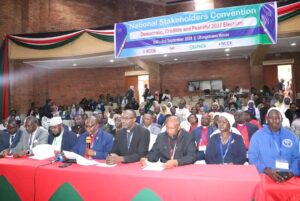
The stakeholders, drawn from six umbrella religious institutions, seven constitutional agencies, five professional bodies and 21 civil society organisations, made the declaration during a two-day National Stakeholders Convention held at Ufungamano House in Nairobi from September 2 to 3, 2026.
The convention sought to assess the preparedness of constitutional institutions to facilitate democratic, credible and peaceful elections while developing collective strategies to safeguard the 2027 electoral cycle.
During the forum, the delegates observed that anxiety and apprehension were escalating as the country approaches the elections, citing memories of violence that accompanied the 1997, 2007 and 2017 polls.
They identified political violence , institutional capture, opaque campaign financing, misinformation and ethnic polarization, as well as the exclusion of youth, women and persons with disabilities from leadership, as some of the principal threats to the electoral process.
On political violence, the stakeholders accused political actors of exploiting young people and allegedly using organized gangs to intimidate citizens and suppress political participation.
They argued that selective policing had created an environment in which the distinction between political gangs and security agencies was increasingly blurred. The religious leaders pledged to publicly campaign for the swift and impartial investigation, arrest and prosecution of individuals who finance political violence, warning that authorities entrusted with investigative and prosecutorial responsibilities would be held accountable for any dereliction of duty.
The convention also expressed concern over what it described as attempts by political actors to capture religious institutions through monetary donations and political patronage. The delegates argued that such donations risk compromising the moral authority and independence of faith institutions, particularly at a time when public confidence in several state institutions remains strained.
Religious umbrella bodies consequently committed themselves to mobilising their congregations to restrict political access to religious platforms and promote anonymized giving in churches and mosques. They further vowed not to allow religious institutions to become instruments for legitimizing political actors.
The stakeholders also condemned the increasing monetization of Kenyan politics, warning that the country risked drifting from democracy towards what they termed “plutocracy” , governance dominated by the wealthy.
According to the communiqué, political money increasingly influences candidate selection, electoral competition, election outcomes and government decision-making, while opaque campaign financing creates opportunities for elite capture and corruption.
The delegates consequently committed themselves to intensifying civic education and public awareness campaigns aimed at helping citizens understand the implications of illicit political financing. Misinformation, disinformation, hate speech and ethnic polarisation were similarly identified as significant threats, with the stakeholders accusing political actors of deliberately constructing divisive “us versus them” narratives to delegitimise opponents and justify their suppression.
Religious leaders pledged to promote narratives that foster national cohesion and to collaborate with other stakeholders in establishing fact-checking mechanisms capable of disseminating credible information.
The convention further highlighted what it described as the structural marginalisation of young people, women and persons with disabilities in political leadership. The stakeholders noted that despite young people below the age of 35 constituting approximately three-quarters of the population, their representation in Parliament remained disproportionately low. Women and persons with disabilities were similarly identified as groups that continue to face significant barriers to political participation and leadership.
The religious institutions pledged to use their networks to promote greater inclusion and support efforts to review laws, policies and institutional practices that impede the participation of these groups in decision-making.
The convention also urged Kenyans to resist political intimidation and election bribery, arguing that violence and economic deprivation have historically been used to discourage citizens from participating in democratic processes. The stakeholders warned that political handouts are often financed either by individuals seeking access to government contracts or through resources allegedly siphoned from public coffers, creating a cycle in which citizens are effectively bribed with resources that should have been used for public development.
They urged voters to reject electoral bribery and demand greater transparency in political financing, arguing that doing so would help dismantle entrenched networks of patronage and corruption surrounding elections.
As Kenya prepares for the 2027 General Election, the stakeholders called for collective vigilance, institutional independence and active citizen participation to prevent the country from relapsing into electoral violence. They maintained that safeguarding democracy cannot be left solely to political leaders or state institutions, insisting that every Kenyan has a responsibility to protect the country’s democratic future.
The covention was graced by representatives including Rt Rev Simon Peter Kamomoe of the Kenya Conference of Catholic Bishops (KCCB), Bishop Dr Calisto Odede of the Evangelical Alliance of Kenya (EAK), Sheikh Abdullah Salat of the Supreme Council of Kenya Muslims (SUPKEM), and Rev Dr Elias Agola.
Facebook Comments Box
About The Author