
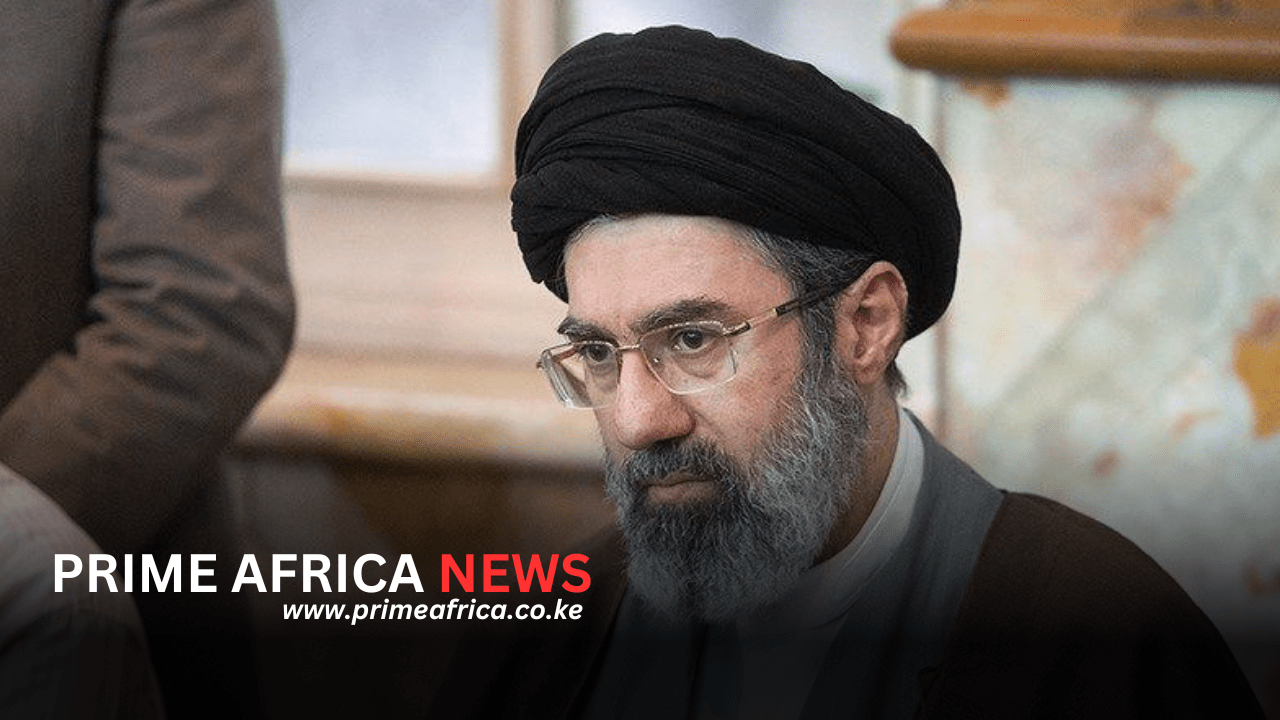

Nairobi, Kenya – Iran has appointed a new Supreme Leader following the death of longtime leader Ali Khamenei, who was killed in recent United States-Israeli strikes during escalating hostilities involving Iran.
[spacer height=”20px”]
The country’s powerful Assembly of Experts on Sunday named his son, Mojtaba Khamenei, as the new Supreme Leader, marking a pivotal moment for the Islamic Republic as it navigates one of the most serious crises in its 47-year history.
[spacer height=”20px”]
The 56-year-old cleric has never held a formal government position but has long maintained strong ties with Iran’s security establishment, particularly the Islamic Revolutionary Guard Corps (IRGC), as well as the influential office of his late father. Analysts describe him as a hardliner likely to maintain continuity in Iran’s political and ideological direction.
[spacer height=”20px”]
Mojtaba Khamenei’s appointment comes just over a week after the death of Ali Khamenei in strikes attributed to the United States and Israel amid the intensifying war involving Iran. The decision also followed personal tragedy for the new leader, who reportedly lost both his father and his wife in the attacks.
[spacer height=”20px”]
Political and military figures across Iran quickly rallied behind the new leader. Among those expressing support were Iran’s President Masoud Pezeshkian and senior political figure Ali Larijani, who currently serves as secretary of the Supreme National Security Council.
[spacer height=”20px”]
Regional and Global Reactions
[spacer height=”20px”]
International reactions to the appointment have been swift and varied.
[spacer height=”20px”]
The Sultanate of Oman, which previously mediated talks between Iran and the United States before the conflict escalated, congratulated the new leader. Haitham bin Tariq Al Said, the Sultan of Oman, sent a formal message of congratulations through the official Oman News Agency.
[spacer height=”20px”]
In neighboring Iraq, Prime Minister Mohammed Shia al-Sudani also extended his congratulations, expressing confidence in Iran’s new leadership during what he described as a “sensitive stage” for the country.
[spacer height=”20px”]
Al-Sudani reiterated Baghdad’s solidarity with Iran and called for an end to military operations that threaten regional stability.
[spacer height=”20px”]
US Skepticism
[spacer height=”20px”]
However, the appointment drew criticism from Donald Trump, President of the United States. Trump had previously dismissed Mojtaba Khamenei as a “lightweight” and argued that Washington should have influence over who leads Iran—an idea strongly rejected by Tehran.
[spacer height=”20px”]
Speaking to NBC News and CBS News on Monday, Trump said he believed Iran had “made a mistake” with the appointment and suggested the leadership change may not last. He also claimed to have someone else in mind to lead Iran but declined to provide details.
[spacer height=”20px”]
Support from Russia and China
[spacer height=”20px”]
Meanwhile, Iran received backing from major global allies.
[spacer height=”20px”]
Vladimir Putin, President of Russia, reaffirmed Moscow’s support for Tehran in a message to the new leader, pledging “unwavering support” and describing Russia as a reliable partner during the ongoing conflict.
[spacer height=”20px”]
China also urged respect for Iran’s sovereignty. Foreign Ministry spokesperson Guo Jiakun said Beijing supports Iran’s constitutional process and opposes external interference in its internal affairs.
[spacer height=”20px”]
China has condemned the killing of the former supreme leader while also urging restraint amid escalating regional tensions.
[spacer height=”20px”]
Support from Regional Allies
[spacer height=”20px”]
Iran’s allies across the Middle East also welcomed the leadership transition.
[spacer height=”20px”]
The Houthi movement in Yemen issued a statement congratulating Mojtaba Khamenei and describing his selection as a victory for the Islamic Revolution.
[spacer height=”20px”]
The group said his leadership comes at a “pivotal juncture” and framed the appointment as a strong message to Iran’s adversaries.
[spacer height=”20px”]
A Critical Moment for Iran
[spacer height=”20px”]
Mojtaba Khamenei now assumes leadership of the Islamic Republic at a time of heightened regional tensions and direct confrontation with the United States and Israel. Observers say his close relationship with the IRGC and conservative religious establishment suggests Iran’s policies are likely to remain firmly aligned with the course set by his father.
[spacer height=”20px”]
His tenure begins amid war, diplomatic isolation in parts of the West, and mounting pressure across the Middle East—making the coming months crucial for both Iran and the wider region.
[spacer height=”20px”]
About The Author

