
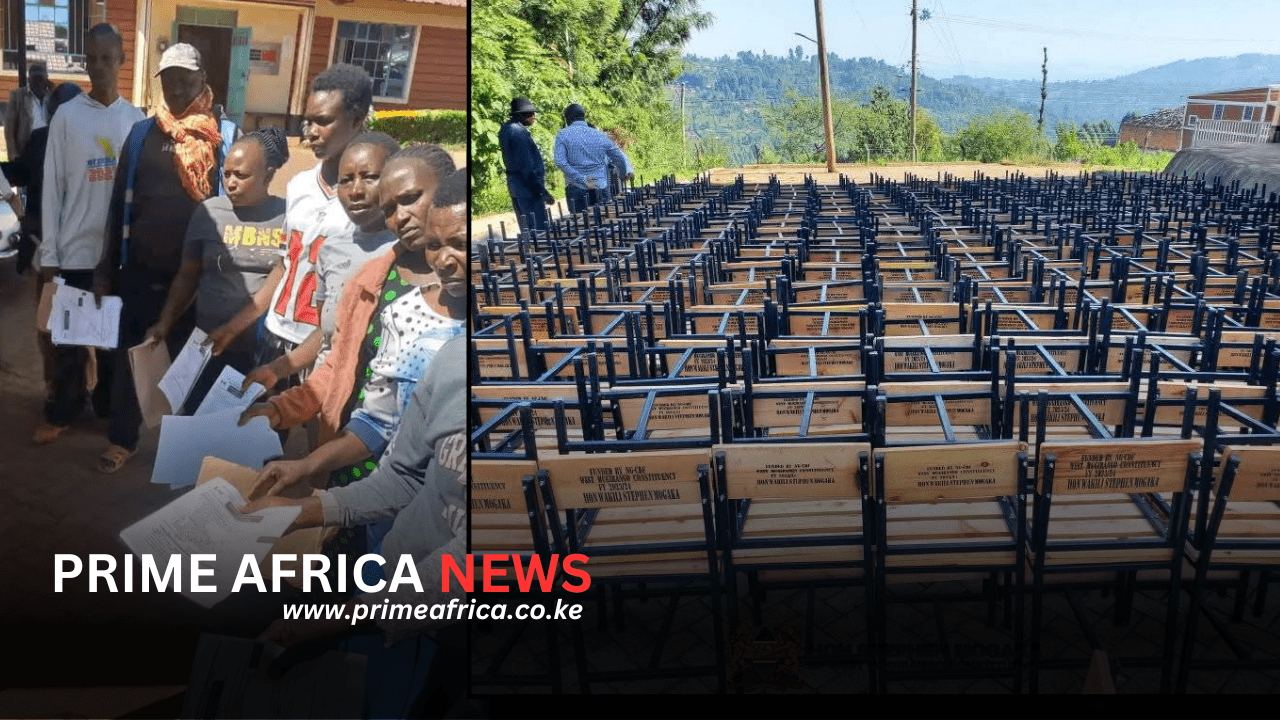

As Kenya continues to grapple with persistent socio-economic inequalities, targeted bursary programmes are emerging as powerful tools for expanding access to education among learners from low-income and vulnerable households. In constituencies such as West Mugirango in Nyamira County and Kiharu in Murang’a County, innovative use of the National Government Constituency Development Fund (NG-CDF) is transforming educational opportunities and offering renewed hope to families struggling to meet the cost of schooling.
[spacer height=”20px”]
Bridging the Gap Through Technology in West Mugirango
[spacer height=”20px”]
In early January 2026, West Mugirango MP Stephen Mogaka unveiled a digital bursary application system designed to enhance transparency, equity and efficiency in the allocation of education support.
[spacer height=”20px”]
The online platform replaces a largely paper-based process that had often been criticised for opacity, delays and inequitable distribution. Applicants now submit their details electronically and receive a QR-authenticated serial number, a feature that significantly reduces opportunities for fraud while improving verification of genuine beneficiaries—particularly students from marginalised and vulnerable backgrounds.
Within days of the launch, the constituency is expected to disburse bursaries to thousands of learners in both secondary schools and tertiary institutions. According to local education stakeholders, about 8,000 secondary school students and nearly 4,000 university and college applicants have successfully secured funding.
[spacer height=”20px”]
“For many families here, a bursary is the difference between staying in school and dropping out,” said a community education advocate. “Even modest financial support helps reduce absenteeism and allows learners to focus on their studies instead of financial survival.”
[spacer height=”20px”]
Kiharu’s “Masomo Bora” Model
[spacer height=”20px”]
In Kiharu Constituency, bursary support forms part of a broader education reform agenda known as Masomo Bora, spearheaded by MP Ndindi Nyoro. The initiative goes beyond conventional bursaries by slashing day secondary school fees to KSh 500 per term, with NG-CDF resources covering feeding programmes, learning materials and infrastructure such as laboratories.
[spacer height=”20px”]

While the heavily subsidised fee structure benefits day scholars, NG-CDF bursaries remain available for students in boarding secondary schools, universities and colleges. Application forms can be downloaded, ensuring continued access to additional support for families with greater financial needs.
Education stakeholders say the model demonstrates how bursaries can be most effective when combined with systemic investments in affordability and quality. “This approach recognises that education must be both accessible and excellent,” said a local school administrator.
[spacer height=”20px”]
Bursaries as Safety Nets Across Kenya
[spacer height=”20px”]
Across Africa, education is widely recognised as a catalyst for socio-economic transformation. However, structural barriers—including household poverty, gender disparities and uneven access—continue to limit opportunities for millions of children.
[spacer height=”20px”]
In Kenya, the NG-CDF remains one of the few constitutional mechanisms that directly support students at the grassroots. When administered transparently and equitably, constituency bursaries help families cope with school fees, examination costs and other incidental expenses, enabling learners to remain in school longer and compete more fairly on a national stage.
Nevertheless, challenges persist. A recent Auditor-General’s report flagged irregularities in bursary fund management in some constituencies, underscoring the need for stronger accountability frameworks, clear eligibility criteria and robust oversight to maintain public trust.
[spacer height=”20px”]
An Uncertain Future for NG-CDF
[spacer height=”20px”]
The impact of bursaries in places like West Mugirango and Kiharu comes at a time of uncertainty for the NG-CDF itself. Following a High Court ruling declaring the fund unconstitutional, NG-CDF is scheduled to cease operations on June 30, 2026, unless Parliament overturns the decision or enacts a new legal framework.
[spacer height=”20px”]
The ruling has sparked widespread debate, as the fund supports critical services including bursaries, classroom construction and community development projects across all 290 constituencies.
[spacer height=”20px”]
For families who rely on bursaries to keep their children in school, the stakes are high. “These funds are not just financial assistance,” said a parent in Nyamira. “They are a lifeline that helps break the cycle of poverty.”
[spacer height=”20px”]
As the legal process unfolds, education advocates and community leaders are calling for reforms that preserve grassroots education support while strengthening governance. Their message is clear: when delivered transparently and innovatively, bursary programmes can unlock human potential and strengthen the social fabric of Kenya’s diverse regions.
[spacer height=”20px”]
About The Author

