
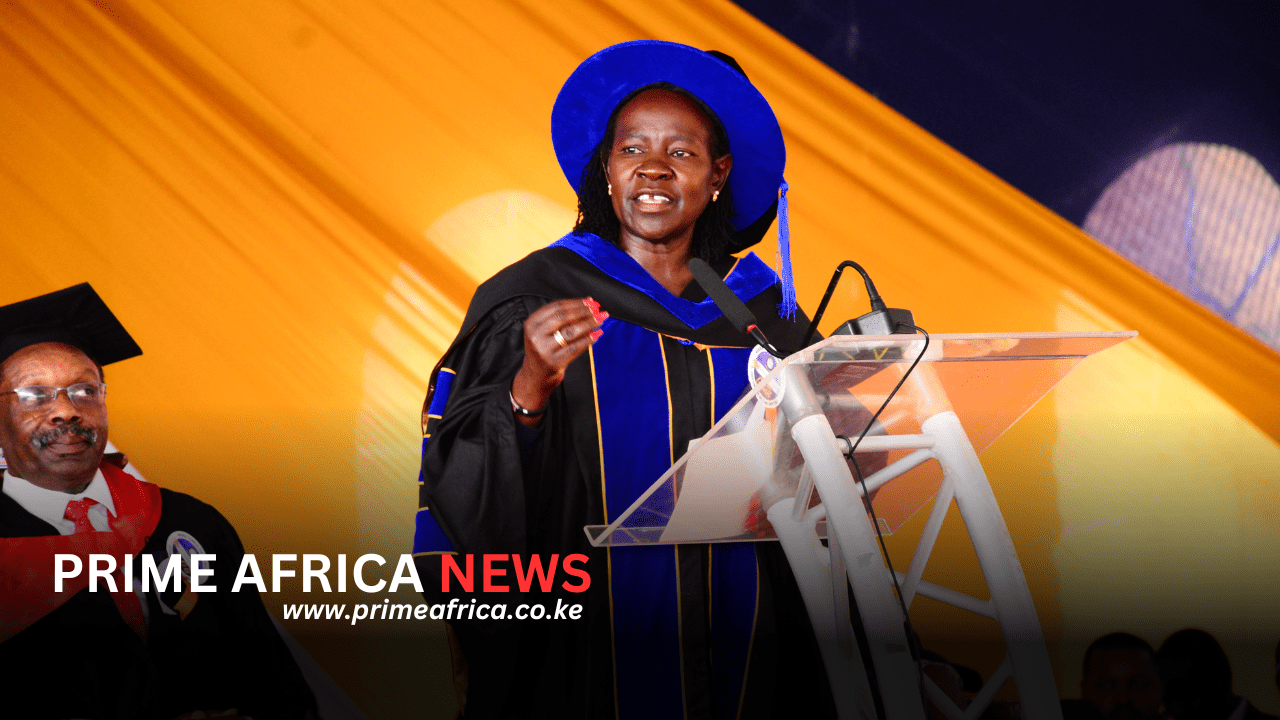

Meru, Kenya — The Principal Secretary in the State Department for Technical and Vocational Education and Training (TVET), Dr. Esther Thaara Muoria, has defended the newly introduced modular learning model, saying it is a game changer that will help young people acquire jobs faster.
[spacer height=”20px”]
Speaking in Meru County during the third graduation ceremony at Mukiiria Technical Training Institute, Dr. Muoria said the modular system is designed to make technical training more flexible, practical, and responsive to the needs of the labour market. The ceremony saw more than 2,200 students graduate in various technical and vocational courses.
[spacer height=”20px”]
Dr. Muoria explained that the modular learning approach breaks long courses into smaller, skill-focused units known as modules. Each module targets specific competencies that are directly demanded by employers, enabling learners to gain employable skills within a shorter period.
[spacer height=”20px”]
“The modular system allows learners to train, get certified, and seek employment without waiting to complete lengthy courses. It is learner-centred and aligned with the realities of today’s job market,” she said.
[spacer height=”20px”]
She added that the model gives students the flexibility to progress at their own pace, return for further training when ready, and continuously upgrade their skills as market demands evolve.
Meru County Commissioner Jacob Ouma lauded the innovation and creativity demonstrated by the graduating students, particularly highlighting locally developed inventions. He cited a handmade flour milling machine designed by students, noting that if produced on a larger scale, it could serve the Kenyan market and generate significant income for the innovators.
[spacer height=”20px”]
“These are practical solutions that can transform lives. With proper support and scaling, such innovations can create jobs and contribute to the country’s economic growth,” Ouma said.
[spacer height=”20px”]
Despite the optimism, the modular model has attracted criticism from some stakeholders who argue that it is more expensive compared to the existing dual training system. Addressing the concerns, Dr. Muoria said the government remains open to dialogue and welcomes input from the public and education stakeholders.
[spacer height=”20px”]
“We are ready to receive suggestions on alternative or complementary training models that are affordable and effective, especially those that can help tackle the rising unemployment challenge,” she said.
[spacer height=”20px”]
The modular TVET model is part of the government’s broader strategy to strengthen skills development, promote innovation, and equip young Kenyans with practical competencies needed to drive industrial growth and self-employment.
[spacer height=”20px”]
