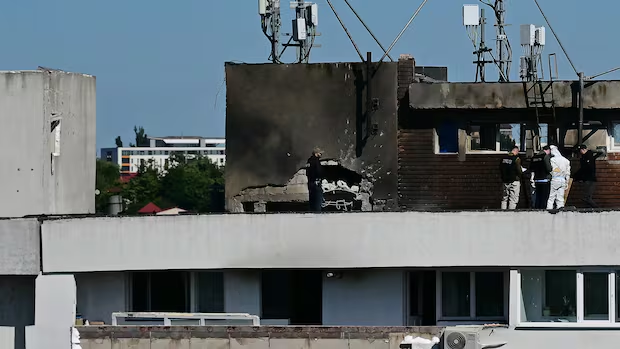

BUCHAREST, Romania – Romania and its NATO allies have strongly condemned a drone strike that crashed into a residential apartment building in eastern Romania, injuring two people and intensifying concerns over the growing risk of the war in Ukraine spilling into NATO territory.
Romania’s Ministry of Foreign Affairs described the incident as a serious violation of international law after the drone, which authorities say was part of a large-scale overnight attack targeting Ukraine, entered Romanian airspace before crashing into an apartment block in the city of Galati.
According to Romanian officials, radar systems tracked the drone as it crossed into the country’s airspace, prompting the deployment of two F-16 fighter jets and a military helicopter. Emergency alerts were issued to residents as the aircraft approached.
The drone struck the roof of a residential building, triggering a fire that forced the evacuation of several residents. Two people sustained minor injuries during the incident.
The latest incursion has heightened fears across Europe that Russia’s war against Ukraine could increasingly affect neighbouring NATO member states.
Several countries along NATO’s eastern flank, including Estonia, Latvia, Lithuania and Finland, have reported repeated airspace violations and drone incursions in recent months. Security concerns have intensified across the region, with governments seeking stronger defensive capabilities against aerial threats.
In response to the Galati incident, Romanian leaders announced plans to accelerate the acquisition of anti-drone defence systems. Outgoing Prime Minister Ilie Bolojan confirmed that Romania would sign a contract under the European Union’s SAFE programme to strengthen its air defence capabilities.
Romania also summoned Russia’s ambassador for urgent consultations.
Foreign Minister Oana Toiu said Bucharest would formally communicate the diplomatic consequences of what she described as Russia’s irresponsible actions and would pursue further measures at both national and European Union levels, including potential sanctions.
President Nicusor Dan vowed that Romania would not allow the effects of Russia’s military campaign in Ukraine to be transferred onto Romanian citizens.
Following a meeting of Romania’s Supreme Council of National Defence, Dan announced that the Russian consul in the Black Sea city of Constanta had been declared persona non grata and that the Russian consulate there would be closed.
The incident drew swift reactions from NATO and European leaders.
French Minister for European Affairs Benjamin Haddad said the strike underscored the dangers Russia poses to European security, particularly as French troops remain deployed in Romania as part of NATO’s regional security framework.
Polish Foreign Minister Radoslaw Sikorski warned that regardless of whether the incident was intentional or accidental, it demonstrated the risks posed by Russia’s military actions.
European Commission President Ursula von der Leyen said the crash showed that Russia’s war of aggression had crossed yet another line, while a NATO spokesperson condemned what was described as Russia’s reckless behaviour.
Ukrainian Foreign Minister Andrii Sybiha pledged close cooperation with Bucharest to strengthen regional air defence systems, arguing that enhancing Ukraine’s own air defence capabilities remains critical not only for Ukraine’s security but also for the protection of neighbouring countries.
Meanwhile, United Nations Secretary-General Antonio Guterres warned that the escalating attacks risk spiralling beyond control with potentially unpredictable consequences.
Guterres noted that civilian casualties during the first four months of 2026 had exceeded those recorded during the same period in the previous three years and renewed calls for immediate de-escalation, diplomacy and a full ceasefire.
Russia, however, disputed allegations that the drone was Russian.
Speaking during a news conference in Astana, Kazakhstan, President Vladimir Putin said it was premature to determine the drone’s origin before a full investigation had been completed.
Putin argued that similar accusations had previously been made following drone incidents in Finland, Poland and the Baltic states, only for later investigations to produce different conclusions.
He called on Romania to share evidence and drone fragments with Moscow to facilitate an independent Russian investigation.
Russian Security Council Deputy Chairman Dmitry Medvedev also questioned the drone’s origin but warned that similar incidents could continue as long as European nations maintain military support for Ukraine.
The incident marks one of the most serious security breaches involving a NATO member since Russia launched its full-scale invasion of Ukraine and is likely to intensify calls across Europe for stronger air defence systems and enhanced regional security cooperation.
About The Author