
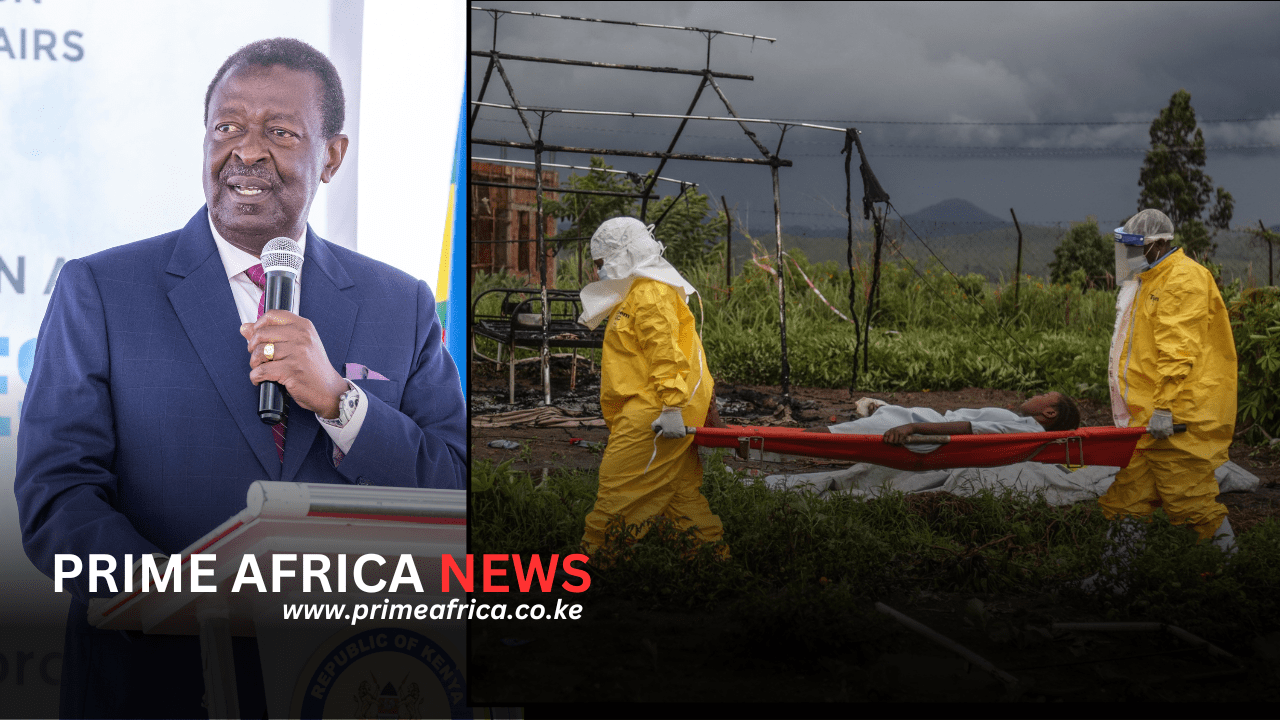

NAIROBI (Prime Africa) – Kenya has intensified its preparedness measures against Ebola and other emerging public health threats as the government moves to strengthen the country’s position as a regional diplomatic and humanitarian coordination hub.
Prime Cabinet Secretary Musalia Mudavadi said the government remains vigilant despite the country recording no confirmed Ebola cases, emphasizing that Kenya’s strategic role as a gateway for trade, diplomacy, and international cooperation demands sustained readiness.
Speaking during the State Department for Foreign Affairs Staff Wellness Day in Nairobi, Mudavadi revealed that the government has held high-level consultations with development partners and the United Nations system following recent regional and global health developments. According to the Prime Cabinet Secretary, President William Ruto has convened discussions aimed at reinforcing Kenya’s preparedness architecture in the event of Ebola-related risks.
“We must remain proactive and vigilant. Complacency is not an option in the face of evolving global health threats,” Mudavadi said.

He noted that Kenya continues to strengthen disease surveillance systems, emergency response mechanisms, and health infrastructure to ensure rapid detection and containment of potential outbreaks.
Mudavadi further stated that Ebola preparedness is no longer solely a health sector issue but has become an important national security and foreign policy consideration requiring coordinated government action.
The Prime Cabinet Secretary also disclosed that Kenya is engaged in ongoing discussions with the United Nations to further position Nairobi as a strategic centre for humanitarian coordination and logistical support within the global South.
“We are engaging the United Nations with a view to ensuring that Kenya is not only a host of international agencies, but also a strategic centre for humanitarian and logistical coordination,” he stated.
He added that Kenya is expanding a network of emergency preparedness and response facilities as part of a broader national resilience and health security framework.
“We are deliberately building capacity not only for national response, but also in recognition of our responsibility within the international system,” Mudavadi added.
During the event, the Prime Cabinet Secretary also underscored the importance of staff wellness and mental health within the foreign service, describing the annual wellness initiative as critical in strengthening institutional resilience and effectiveness.
Kenya Confirms Talks With US on Ebola Response Amid Reports of Planned Isolation Facility
He commended the State Department for Foreign Affairs under Principal Secretary Korir Sing’Oei for sustaining the programme, saying it promotes team building, stress management, and institutional cohesion.
Mudavadi warned that stress, anxiety, and burnout continue to affect workforces globally and urged public servants to seek psychosocial support whenever necessary.
“Work-related stress often manifests silently, affecting individuals who continue to serve with dedication despite personal challenges,” he observed.
He encouraged employees to embrace a culture of empathy and openness, emphasizing that seeking support should be viewed as a sign of strength and responsibility.
“Seeking assistance reflects courage, maturity, and a commitment to personal and professional well-being,” he said.
Mudavadi concluded by reaffirming the government’s commitment to strengthening workplace wellness frameworks and supporting public servants in the effective delivery of Kenya’s foreign policy objectives.
About The Author

