

Nairobi, Kenya – In a move drawing widespread condemnation across Africa and beyond, U.S. President Donald Trump signed a sweeping proclamation on Wednesday that bans citizens from 12 countries — including six African nations — from entering the United States, citing concerns over terrorism and immigration enforcement failures.
[spacer height=”20px”]
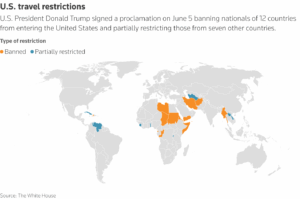
The directive, part of Trump’s hardline immigration agenda in his second term, takes effect on June 9, 2025, at 12:01 a.m. EDT (0401 GMT). It restricts full entry to nationals of Afghanistan, Myanmar, Chad, Congo Republic, Equatorial Guinea, Eritrea, Haiti, Iran, Libya, Somalia, Sudan, and Yemen. An additional seven countries — Burundi, Cuba, Laos, Sierra Leone, Togo, Turkmenistan, and Venezuela — will face partial restrictions.
[spacer height=”20px”]
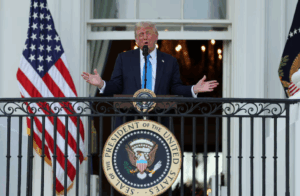
“We will not allow people to enter our country who wish to do us harm,” Trump said in a video message posted to social media platform X, hinting that the list could expand further.
[spacer height=”20px”]
African Union Reacts
[spacer height=”20px”]
The African Union Commission expressed deep concern Thursday over the travel ban’s potential to erode educational ties, hamper trade, and undermine diplomatic relations between Africa and the United States.
[spacer height=”20px”]
“This sweeping and discriminatory measure risks reversing decades of progress in U.S.-Africa cooperation,” an AU statement read.
[spacer height=”20px”]
Regional Outrage and Retaliation
[spacer height=”20px”]
Chad, one of the countries hit hardest by the ban, wasted no time in retaliating. President Idriss Deby ordered an immediate halt to the issuance of visas for U.S. citizens, citing unfair targeting and the lack of consultation.
[spacer height=”20px”]
In Congo Republic, government spokesperson Thierry Moungalla dismissed the inclusion of his country as a “misunderstanding,” declaring: “Congo is neither a terrorist state, nor does it harbor or support terrorist activities. This is an unfortunate error.”
[spacer height=”20px”]
Other African capitals remained cautiously silent, though diplomatic sources say discussions are underway behind the scenes on a coordinated African response.
[spacer height=”20px”]
Broader Crackdown
[spacer height=”20px”]
The travel restrictions mark a sharp escalation in President Trump’s broader immigration clampdown. Since resuming office in 2025, Trump has ramped up deportations — including the controversial expulsion of hundreds of Venezuelan nationals to El Salvador — and curtailed student visas for several foreign programs.
A Boulder, Colorado attack on pro-Israel demonstrators, allegedly committed by Egyptian national Mohamed Sabry Soliman, was cited as justification for the new order. Soliman had overstayed his tourist visa, although Egypt is not on the list of targeted countries.
[spacer height=”20px”]
Implications for Education and Migration
[spacer height=”20px”]
The ban has cast a shadow over international academic programs. A 31-year-old teacher from Myanmar, accepted into a prestigious U.S. State Department exchange program, expressed despair over the uncertain future of her placement.
[spacer height=”20px”]
“It’s not easy to get accepted — we needed several recommendations and interviews,” she told Prime Africa News from Thailand. “I’m still waiting to hear what happens next.”
[spacer height=”20px”]
African Governments Call for Dialogue
[spacer height=”20px”]
Somalia’s Ambassador to the U.S., Dahir Hassan Abdi, took a conciliatory tone, emphasizing the nation’s willingness to collaborate on security concerns. “Somalia values its longstanding relationship with the United States,” he said in a statement.
[spacer height=”20px”]
Meanwhile, Venezuelan Interior Minister Diosdado Cabello, a close ally of President Nicolás Maduro, slammed the decision, branding the U.S. government as “fascist” and warning citizens that “being in the United States is a big risk for anybody, not just for Venezuelans.”
[spacer height=”20px”]
A Controversial Legacy Revived
[spacer height=”20px”]
Trump’s latest order revives memories of his controversial 2017 “Muslim ban,” which targeted several Muslim-majority nations and was ultimately upheld by the U.S. Supreme Court in 2018. That ban was repealed by his Democratic successor, President Joe Biden, in 2021, who denounced it as “a stain on our national conscience.”
[spacer height=”20px”]
Now reinstated under a broader pretext of national security, the new ban has reignited debates over xenophobia, global diplomacy, and the future of U.S.-Africa relations.
[spacer height=”20px”]
About The Author

