
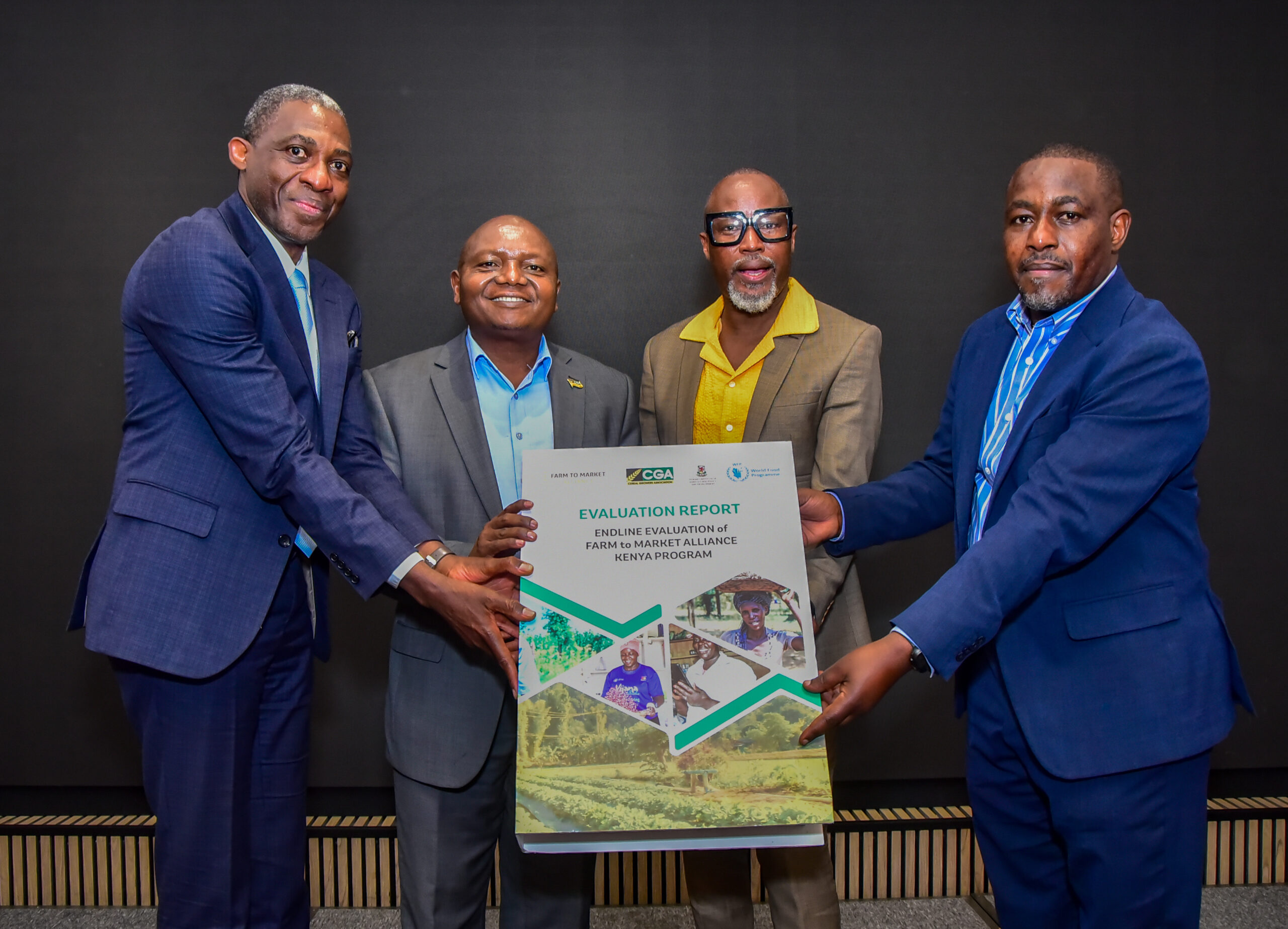

NAIROBI, Kenya – Smallholder farmers across Kenya have recorded significant gains in agricultural productivity, market access and agribusiness development, according to a new nine-year impact evaluation of the Farm to Market Alliance (FtMA) programme.
The findings were unveiled during the 2026 FtMA National Stakeholder Forum, hosted by the Cereal Growers Association (CGA), the World Food Programme (WFP) and other partners at Best Western Premier in Westlands, Nairobi.
Held under the theme “Strengthening Local Food Systems: The FtMA 9-Year Journey,” the forum brought together representatives from the National and County Governments, financial institutions, private-sector off-takers and agripreneurs to assess the programme’s achievements and discuss the next phase of Kenya’s food systems transformation.
The evaluation highlights the programme’s contribution to helping smallholder farmers transition from subsistence farming to commercially viable agriculture through improved access to information, agricultural inputs, financing, technical support and reliable markets.
Since its implementation began in 2017, FtMA has expanded from two counties to 13 counties, establishing a network of 2,126 Farmer Service Centres (FSCs) that now reach approximately 401,955 farmers.
The programme has facilitated the marketing of 664,009 metric tonnes of agricultural produce, while contributing to an 88 per cent adoption rate of certified seeds among participating farmers.
The evaluation also indicates a 60 per cent increase in maize yields among farmers practising Conservation Agriculture, demonstrating the potential of sustainable farming approaches to improve productivity and strengthen resilience.
One of the key findings from the evaluation is the growing economic contribution of women in smallholder agriculture.
According to the report, women farmers within the FtMA network earn more per hectare than their male counterparts, despite cultivating smaller plots and having comparatively limited access to mechanisation and capital.
Women also recorded the highest level of trust in rural agricultural hubs, at 52 per cent, highlighting the importance of Farmer Service Centres in providing farmers with essential services and market connections.
However, the evaluation identifies persistent challenges, particularly limited access to agricultural equipment, credit facilities and markets, which continue to constrain women’s full participation in commercial agriculture.
The forum also showcased individual success stories demonstrating how access to agricultural training and market linkages can transform smallholder farming into sustainable businesses.
Hannah Njeri, a Farmer Service Centre representative, shared how training through the programme had changed her approach to agriculture, enabling her to expand her farming operations and invest in mechanisation.
“I’m pleased to see young farmers grow and making an impact in the agriculture sector. I only knew business at home, but after getting trained, things changed. Now I have two tractors, and I’m also training other farmers so that no one is left behind,” said Njeri.
Another success story was that of Sylvia Akoli Ayoo, who transitioned from growing groundnuts to establishing a value-addition enterprise.
Ayoo, the Chief Executive Officer of Pebu Enterprises, said her business focuses on processing groundnuts, sweet potatoes and other agricultural produce, with plans to establish a mini-factory to create employment opportunities in Migori County and beyond.
“I’m now the CEO of Pebu Enterprises, where we do value addition for groundnuts, sweet potatoes and other farm produce. We are planning on constructing a mini-factory that can employ more people in Migori and other regions in the country,” she said.
Representing Cabinet Secretary for Agriculture and Livestock Development Mutahi Kagwe, Hez Gikang’a acknowledged the programme’s achievements while calling for greater investment in farmers’ skills and capacity development.
Tracing the programme’s origins to gaps in how smallholder farmers were being served, Gikang’a emphasised the need to move beyond impressive programme statistics and prioritise practical skills that enable farmers to improve their businesses.
“The numbers are great, but we should focus more on skills,” he said.
In his remarks, the Cabinet Secretary called for stronger public-private partnerships to mobilise investment, expand opportunities for smallholder farmers and strengthen evidence-based decision-making, learning and accountability across the agricultural sector.
The Government further reaffirmed its commitment to working with development partners, private-sector players and farmer organisations to increase agricultural productivity, improve market access and expand the participation of women and young people in the sector.
It also underscored the importance of climate-resilient agriculture and sustainable economic opportunities as part of broader efforts to strengthen Kenya’s food systems.
Sustaining the Gains Beyond Nine Years
FtMA has been implemented on the ground by the Cereal Growers Association since 2017, with support from the World Food Programme, NORAD, the Government of New Zealand, the Mastercard Foundation, Bayer, Yara, Syngenta, OCP and Greenlife.
The nine-year evaluation provides an opportunity for stakeholders to reflect on the programme’s impact while identifying gaps that require attention as Kenya seeks to build a more productive, inclusive and market-oriented agricultural sector.
With more than 401,000 farmers reached through its network, the next phase will require sustained investment in farmer training, affordable financing, mechanisation, value addition and stronger market linkages.
The discussions at the 2026 National Stakeholder Forum reinforced the need for coordinated action between government, development partners, financial institutions and private-sector players to ensure smallholder farmers are not only food producers but also competitive agribusiness entrepreneurs.
About The Author


