
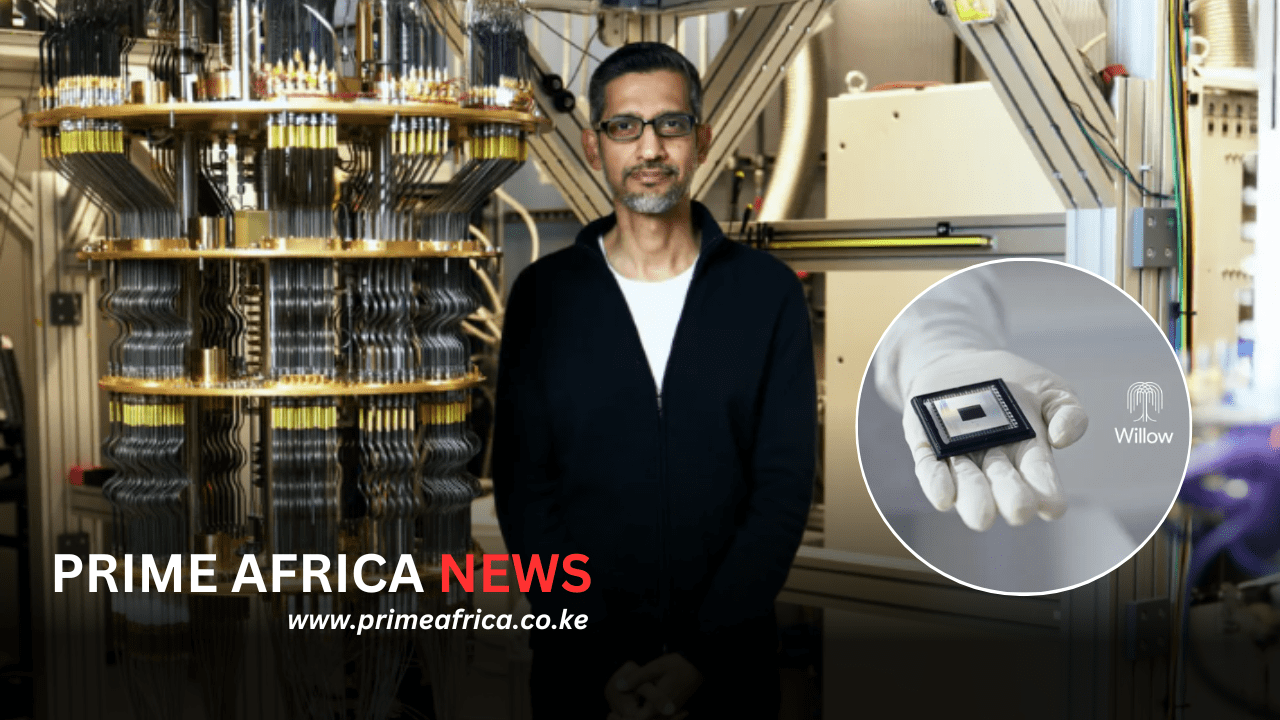

NAIROBI, Kenya – (Prime Africa Tech Desk) In a historic milestone for science and technology, researchers have announced the first-ever demonstration of a verifiable quantum advantage, showing that a quantum computer can run a real, checkable algorithm faster than even the world’s most powerful classical supercomputers.
[spacer height=”20px”]
Google Quantum AI has announced a landmark breakthrough in computing, unveiling what it describes as the first verifiable quantum advantage with real-world applications—a development that marks a decisive shift from theoretical quantum experiments to practical quantum computing.
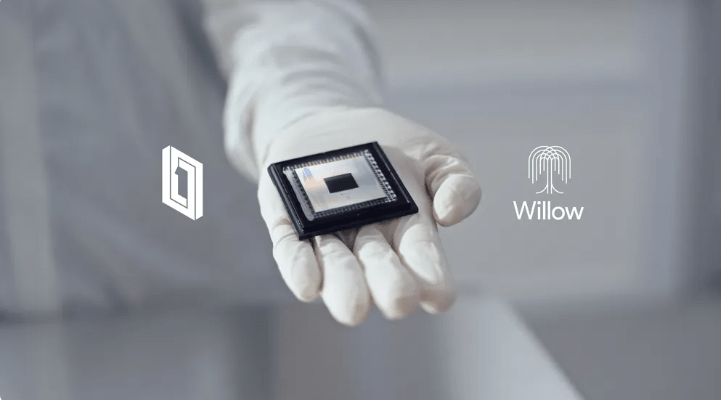
At the center of the breakthrough is Willow, Google’s 105-qubit superconducting quantum processor, which successfully ran a new algorithm known as Quantum Echoes, outperforming the fastest classical supercomputers by a factor of 13,000. The results were published on Wednesday.
According to Google, this is the first time in history that a quantum computer has executed a verifiable algorithm—one whose results can be reliably reproduced—that surpasses the capabilities of classical supercomputers while addressing problems with clear scientific and industrial relevance.
“This is the first time any quantum computer has successfully run a verifiable algorithm that surpasses the ability of supercomputers,” Google said in a statement.
[spacer height=”20px”]
From Experimental Milestones to Practical Computing
[spacer height=”20px”]
Unlike earlier quantum milestones that focused on abstract or synthetic problems, Google emphasized that this achievement represents a practical turning point.
[spacer height=”20px”]
“Quantum verifiability means the result can be repeated on our quantum computer—or any other of the same caliber—to get the same answer, confirming the result,” the company explained. This reproducibility distinguishes the breakthrough from prior experimental demonstrations that could not be independently validated.
[spacer height=”20px”]
The company noted that the 13,000x speed advantage refers specifically to the out-of-time-order correlator (OTOC) algorithm running on Willow, compared against the best known classical algorithm on one of the world’s fastest supercomputers, though the specific system was not disclosed.
[spacer height=”20px”]
How Quantum Echoes Works
[spacer height=”20px”]
The Quantum Echoes algorithm measures how disturbances spread through quantum systems. It does so by sending precisely engineered signals through Willow’s qubits, perturbing a single qubit, and then reversing the system’s evolution to detect a returning “echo.”
[spacer height=”20px”]
“This quantum echo is special because it gets amplified by constructive interference, where quantum waves add up to become stronger,” Google said. “This makes our measurement incredibly sensitive.”
[spacer height=”20px”]
That sensitivity allows scientists to extract structural information about complex quantum systems—an ability that has far-reaching implications for chemistry, materials science, and physics.
[spacer height=”20px”]
Breakthrough Applications in Molecular Science
[spacer height=”20px”]
[spacer height=”20px”]
In a proof-of-principle experiment conducted in collaboration with the University of California, Berkeley, researchers used Quantum Echoes alongside Nuclear Magnetic Resonance (NMR) data to analyze molecules containing 15 and 28 atoms.
[spacer height=”20px”]
The quantum results matched traditional NMR measurements while also revealing structural details not typically accessible through classical methods.
[spacer height=”20px”]
“Quantum computing-enhanced NMR could become a powerful tool in drug discovery, helping determine how potential medicines bind to their targets,” Google said. The technique could also accelerate innovation in materials science, including polymers, battery components, and next-generation semiconductor materials.
[spacer height=”20px”]
Intensifying Global Quantum Race
[spacer height=”20px”]
The announcement places Google at the forefront of an increasingly competitive quantum computing landscape. IBM is targeting a 200-logical-qubit system known as Starling by 2029, while Microsoft unveiled its Majorana 1 chip in early 2025, citing a path toward one million qubits using topological technology. Meanwhile, IonQ has reported quantum speed advantages in medical device simulations using trapped-ion systems.
[spacer height=”20px”]
Despite the race, no classical computing counterclaims have yet emerged challenging Google’s Quantum Echoes results—unlike the controversy that followed the company’s 2019 quantum supremacy announcement.
[spacer height=”20px”]
Hardware Powering the Breakthrough
[spacer height=”20px”]
The success of Quantum Echoes rests on Willow’s exceptional hardware performance. Google reported fidelities of 99.97% for single-qubit gates, 99.88% for two-qubit entangling gates, and 99.5% for readout, operating at speeds measured in tens to hundreds of nanoseconds.
[spacer height=”20px”]
The research required an unprecedented scale of experimentation. “This speed enabled a staggering one trillion measurements—a significant portion of all measurements ever performed on quantum computers combined,” Google said.
[spacer height=”20px”]
What Comes Next
[spacer height=”20px”]
The announcement marks another milestone in Google’s quantum roadmap, following its 2019 beyond-classical computation claim, its 2023 quantum error-correction breakthrough, and its 2024 demonstration of below-threshold error correction using Willow.
[spacer height=”20px”]
“Today’s demonstration marks a significant step toward the first real-world applications of quantum computing,” Google said, adding that its next target is the creation of a long-lived logical qubit.
[spacer height=”20px”]
However, major challenges remain. Scaling quantum systems to millions of components with consistent reliability will require years of engineering advances. While Google did not provide a timeline for commercial deployment, the implications for enterprises—from drug discovery to clean energy and advanced manufacturing—are profound.
[spacer height=”20px”]
For the first time, quantum computing is no longer just a promise of the future—it is beginning to deliver verifiable results that could reshape science and industry.
[spacer height=”20px”]
About The Author

