
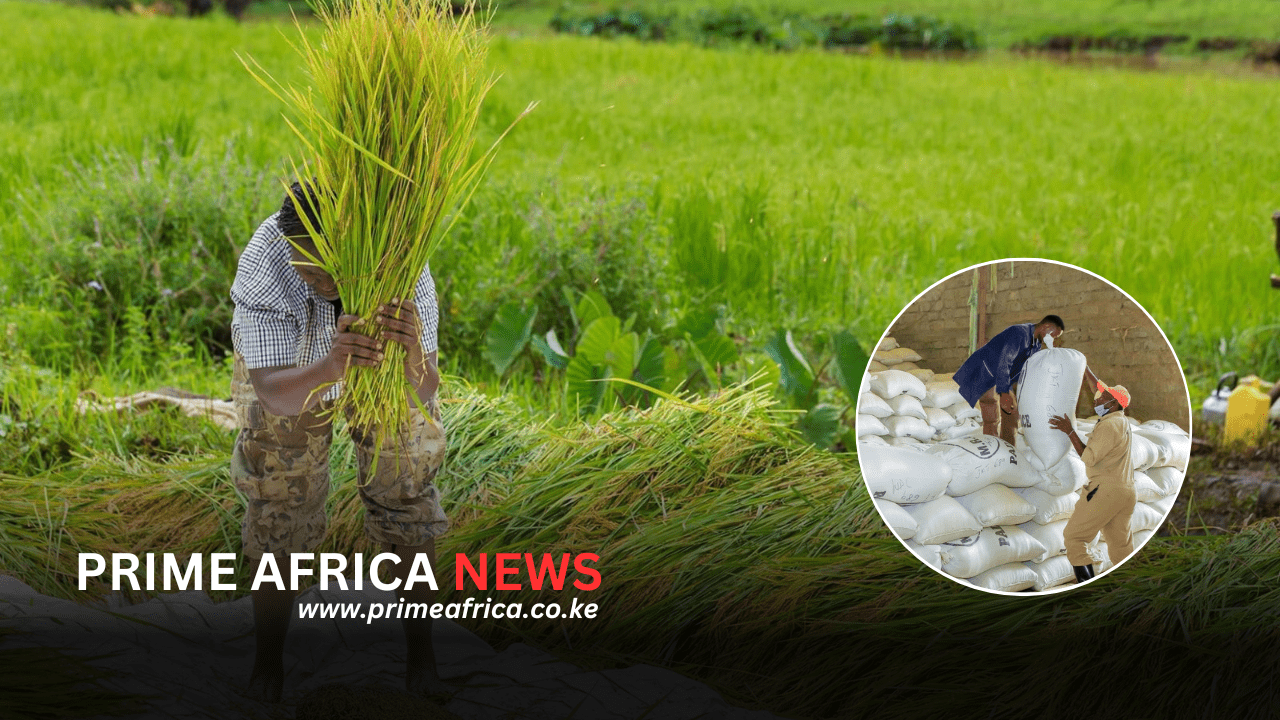

Mwea, Kenya — Rice farmers in Mwea and other major production areas have received a major boost after cooperatives confirmed that all locally produced rice delivered has been fully taken up and paid for, easing fears of stock accumulation and delayed payments that have previously affected the sector.
This assurance was given during a high-level visit to the Mwea Rice Growers Multipurpose Co-operative Society (MRGM) by senior government officials led by Agriculture and Food Authority (AFA) Director General Dr. Bruno Linyiru, accompanied by:Peter Owoko, Acting Agriculture Secretary, State Department for Agriculture,Samuel Ndung’u Karogoh, Managing Director, National Cereals and Produce Board (NCPB), Calistus Kundu, Director of Crops, AFA, Lucy Anangwe, Managing Director, Kenya National Trading Corporation (KNTC).
The visit aimed to assess rice uptake, payments, and farmer concerns amid ongoing public debate around imports and domestic production.
Speaking during the visit, MRGM Chairperson Ndege Muriuki and Managing Director Anthony Waweru confirmed that offloading of rice stocks has been ongoing smoothly, with no complaints from farmers.
“Offloading of stocks has been happening, and we have no complaint. Payment was done as agreed by KNTC,” said Waweru.
He added that the cooperative recorded a carry-over of less than 1 percent from 2025 into 2026, a sharp improvement compared to nearly 30 percent carry-over the previous year.
“As of 31st December, I can confirm that KNTC has paid for all rice that was delivered. Based on our projections, KNTC is ready to take up all the rice that farmers bring,” he said.
Founded in 1964, MRGM is the oldest and largest rice cooperative in the country, representing farmers in the Mwea Irrigation Scheme, which produces about 65 percent of Kenya’s total rice output.
The cooperative also dismissed concerns that rice imports are hurting local farmers, noting that Mwea rice occupies a premium niche market that does not compete with imported rice.
“Our rice is niche and premium. There is no competition between imported rice and locally produced Pishori,” Waweru explained.
While imported rice retails at Kshs 80–100 per kg, Mwea Pishori consistently sells at Kshs 140–160 per kg, reflecting its superior aroma and quality. Popular varieties include Pishori and Komboka, which command higher prices than imported non-basmati rice.
Kenya grows rice in two irrigated seasons and one rain-fed season. The main irrigated season runs from January–February planting to June–August harvesting, mainly in Mwea, Ahero, West Kano, Bunyala, and Perkerra. A second irrigated season is harvested in November–December, while rain-fed rice depends on long rains and is more variable.
Over the past three years, production has steadily increased:
1. 123,916 MT of milled rice in 2022
2. 137,438 MT in 2023
3. 169,291 MT in 2024
In 2026, paddy production is projected to reach 302,000 MT, equivalent to 181,200 MT of milled rice, demonstrating strong sector growth.
However, domestic production still meets less than 20 percent of national consumption, as demand continues to rise due to population growth, urbanization, and changing diets. This makes strategic rice importation necessary to stabilize supply and prices.
Government data shows that imports help stabilize prices without undermining local producers. In August 2025, non-basmati rice retailed at Kshs 166–189 per kg. After the importation of 250,000 MT in November 2025, prices dropped to Kshs 149–155 per kg, benefiting consumers. By December, prices rose again to Kshs 172–175 per kg as supplies tightened.
Importantly, over 95 percent of imported rice is non-basmati, meaning it does not affect the premium Pishori market.
To address persistent marketing challenges—such as low farm-gate prices, storage constraints, delayed payments, and high production costs—the government has strengthened structured marketing through NCPB and KNTC.
Since 2023, KNTC has procured significant volumes of rice directly from farmers, while NCPB continues to offer storage and grain marketing services.
During the visit, the government reaffirmed its commitment to farmers, pledging that all paddy and milled rice offered for sale will be purchased, with payment guaranteed within 30 days of delivery.
“This ensures that every available bag of locally produced rice is taken up promptly, protects farmers from market volatility, and encourages increased production while complementing strategic imports,” said AFA Director General Dr. Bruno Linyiru, MBS.
Farmers with rice stocks have been urged to contact NCPB or KNTC for immediate sale.
About The Author

