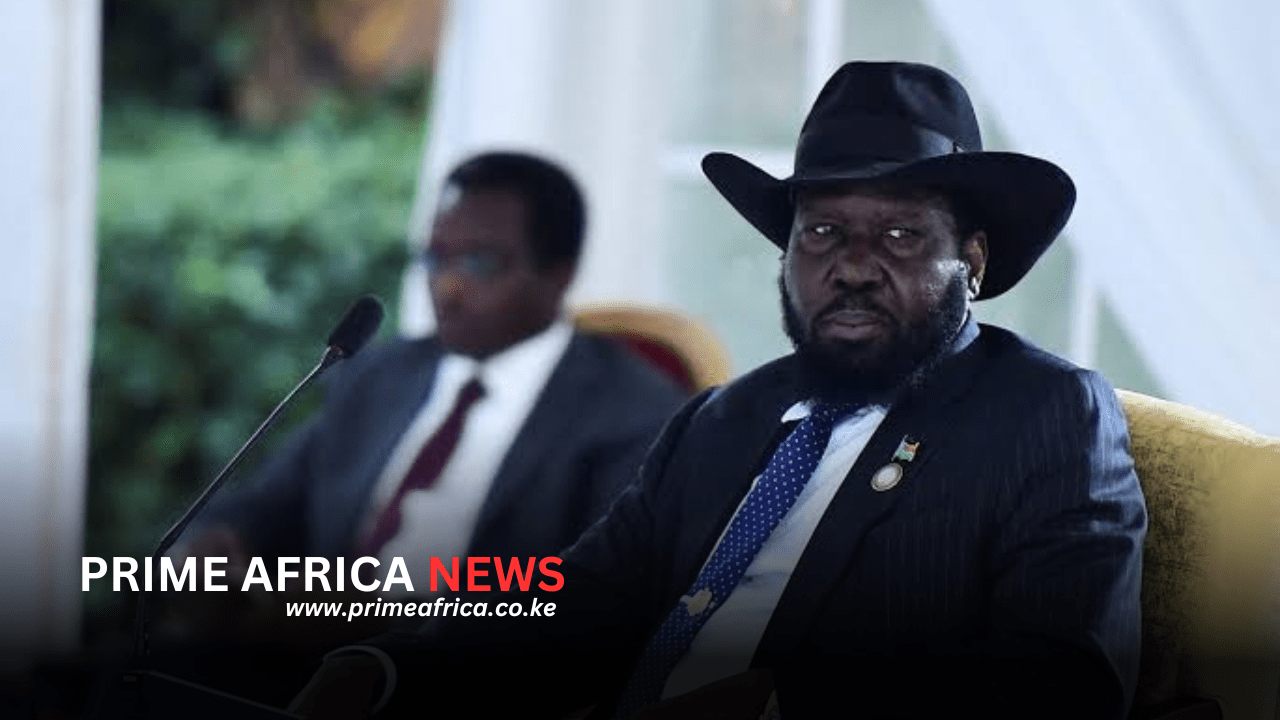

South Sudan – Civil society leader Edmond Yakani says unresolved historical grievances among political leaders are fueling divisions and undermining prospects for a peaceful democratic transition in South Sudan.
[spacer height=”20px”]
In audio shared with Prime Africa News Correspondent in Juba, the Executive Director of Community Empowerment for Progress Organization (CEPO), said, South Sudan is unlikely to hold credible, peaceful and non-violent elections unless political leaders first engage in an inclusive national dialogue that brings all stakeholders on board.
[spacer height=”20px”]
Edmond Yakani emphasized that the country’s political transition continues to be hindered by deep-rooted historical grievances among the political elite, which he believes have shaped their approach to governance and conflict resolution.
[spacer height=”20px”]
“Therefore, the current call for elections without an inclusive political dialogue means we may not see any credible, peaceful and non-violent elections,” Yakani said in a public statement.
[spacer height=”20px”]
Drawing on CEPO’s monitoring of the implementation of the 2018 Revitalized Peace Agreement, the Tumaini peace initiative, and mediation efforts involving the Sant’Egidio Community, Yakani argued that South Sudan’s leaders remain trapped by unresolved experiences from the country’s liberation struggle.
[spacer height=”20px”]
According to Yakani, those historical grievances continue to influence political behavior, fostering a belief that violence remains an effective means of resolving political disputes instead of peaceful dialogue.
[spacer height=”20px”]
“We are fully convinced that the current political class administering public governance has serious issues to deal with,” he said. “Their historical grievances have shaped their thinking, beliefs and approach towards transitioning South Sudan from violence to peace.”
[spacer height=”20px”]
Yakani said these attitudes have contributed to repeated political deadlock, including disagreements over the electoral process and what he described as efforts by both government and opposition actors to shift the political goalposts, making the path to elections increasingly uncertain.
[spacer height=”20px”]
He also accused political leaders of failing to embrace recommendations emerging from previous national dialogue initiatives, saying citizens’ calls for reforms have largely been ignored.
[spacer height=”20px”]
The activist urged the government to take primary responsibility for ensuring a genuine political transition by convening an inclusive dialogue in line with recommendations contained in the African Union C5 declaration. Such a process, he said, should take place before campaigning or voting begins and should include all political actors without preconditions.
[spacer height=”20px”]
“South Sudanese should first hold an inclusive political dialogue that leaves no one behind. It should be a dialogue where everyone feels safe and secure, and where historical grievances no longer determine the country’s future.”
[spacer height=”20px”]
He cautioned that failure to pursue such a process risks entrenching a culture in which violence becomes the accepted method of settling political disagreements, with ordinary citizens continuing to bear the heaviest cost.
[spacer height=”20px”]
“The current and future generations should not pay with their lives and property because political leaders have failed to change attitudes shaped during the liberation struggle,” he said.
[spacer height=”20px”]
He called on both the incumbent government and opposition leaders to seize what he described as a remaining opportunity to place peace above political rivalries.
[spacer height=”20px”]
“You still have the chance to demonstrate leadership by engaging in an inclusive political dialogue that leaves no one behind. That is the only path toward lasting peace, stability and credible elections in South Sudan.”
[spacer height=”20px”]
His remarks come at a time of heightened political uncertainty in South Sudan, where regional and international actors have stepped up diplomatic efforts to prevent further deterioration of the peace process.
[spacer height=”20px”]
The country’s transitional government has faced mounting pressure to fully implement the outstanding provisions of the 2018 Revitalized Peace Agreement, including security reforms, constitutional-making, and preparations for the country’s long-delayed general elections.
[spacer height=”20px”]
The African Union’s C5 High-Level Ad Hoc Committee on South Sudan, following its recent summit, urged South Sudan’s political leaders to pursue an inclusive political dialogue aimed at restoring trust among the parties and creating conditions for a peaceful democratic transition.
[spacer height=”20px”]
The committee also called for the release of First Vice President Dr. Riek Machar, whose continued detention has become a major point of concern for regional and international mediators seeking to preserve the fragile peace agreement.
[spacer height=”20px”]
Similar appeals have been made by the United Nations, the Intergovernmental Authority on Development (IGAD), the African Union, the Troika countries comprising the United States, the United Kingdom and Norway, and other international partners.
[spacer height=”20px”]
They have repeatedly urged South Sudan’s leaders to de-escalate political tensions, safeguard civic and political space, and return to dialogue to prevent the country from sliding back into widespread violence.
[spacer height=”20px”]
The warnings come as South Sudan moves closer to its planned general elections after the National Elections Commission announced that polling will take place on December 22, 2026. Electoral institutions have begun preparatory activities, including constituency delimitation and planning for voter registration.
[spacer height=”20px”]
However, civil society organizations, election observers and international partners have continued to question whether the political, legal and security conditions necessary for credible elections are in place, citing delays in implementing key provisions of the peace agreement, restrictions on political freedoms, and persistent insecurity in parts of the country.
[spacer height=”20px”]
Yakani said these concerns reinforce the need for an inclusive political settlement before the electoral process advances further. He argued that elections held without broad political consensus risk deepening divisions rather than strengthening democracy, citing that unresolved grievances among political leaders could undermine both the credibility of the vote and the country’s long-term stability.
[spacer height=”20px”]
About The Author