


KIGALI, (Prime Africa News) – Rwanda has announced plans to withdraw from the Economic Community of Central African States (ECCAS), signaling escalating diplomatic tensions in the region, particularly over the ongoing offensive by M23 rebels in eastern Democratic Republic of Congo (DRC), widely believed to be backed by Kigali.
The move follows a contentious ECCAS summit held Saturday in Equatorial Guinea, where Rwanda was expected to assume the chairmanship of the 11-member bloc. Instead, the group extended Equatorial Guinea’s leadership—a decision Rwanda’s Foreign Ministry decried as a breach of protocol and a violation of the country’s rights as a member state.
In a strongly worded statement, Rwanda accused the DRC of “instrumentalizing” ECCAS for its own political purposes. “We see no justification for remaining in an organization whose current functioning runs counter to its founding principles,” the ministry said, although it did not specify whether the withdrawal would take immediate effect.
The office of Congolese President Felix Tshisekedi said ECCAS leaders had formally acknowledged “the aggression against the Democratic Republic of Congo by Rwanda” and called for the immediate withdrawal of Rwandan troops from Congolese territory.
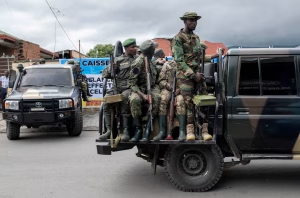
The M23 rebel group, reportedly supported by Rwanda, has captured several strategic towns in eastern Congo, including the region’s two largest cities earlier this year. The fighting has claimed thousands of lives and displaced countless others, raising fears of a broader regional conflict.
Efforts to de-escalate the crisis have seen African leaders join forces with mediators from Washington and Doha to pursue a diplomatic resolution. Still, tensions remain high, particularly over accusations by the United Nations and Western governments that Rwanda has supplied arms and fighters to M23 rebels. Kigali continues to deny the allegations, insisting its military actions are purely defensive, targeting Congolese army units and Hutu militias linked to the 1994 Rwandan genocide, which claimed nearly 1 million lives—predominantly ethnic Tutsis.
The geopolitical stakes are further intensified by the mineral-rich terrain of eastern Congo, home to vast reserves of tantalum, cobalt, copper, lithium, and gold—resources critical to global supply chains in energy and technology.
Sources suggest the administration of former U.S. President Donald Trump had explored brokering a peace agreement between Kigali and Kinshasa, one that could potentially unlock billions in Western investments tied to mineral extraction and infrastructure development in the region.
Founded in the early 1980s, ECCAS aims to promote economic integration, peace, and regional security among Central African states. Rwanda’s departure, if finalized, would mark a major setback for the bloc’s unity and its role as a regional arbitrator.
About The Author

