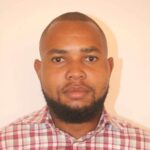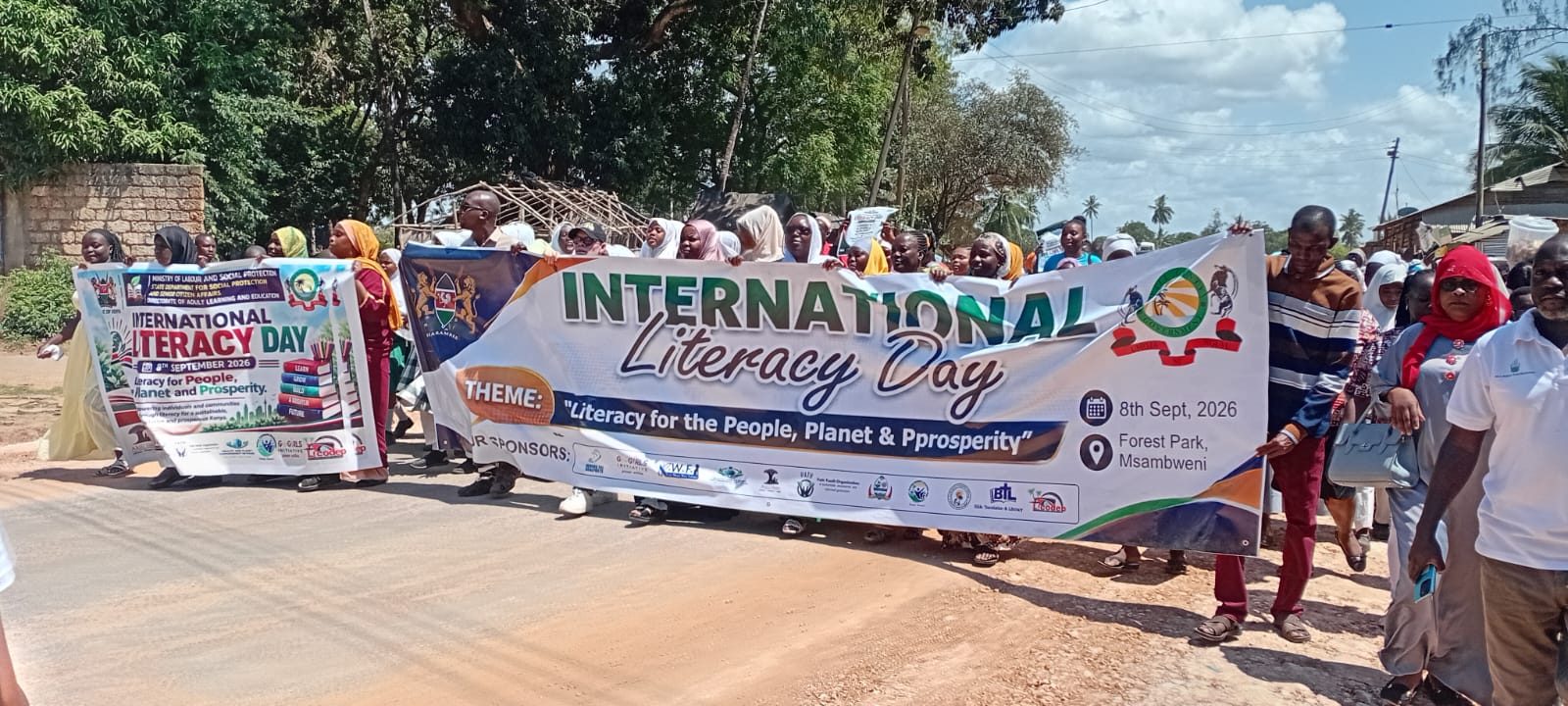

MSAMBWENI, Kwale — For Imam Mwinyi Sauti, returning to school as an adult was never simply about learning to read and write. It was about reclaiming opportunities that slipped away when poverty forced him out of school.
[spacer height=”20px”]
Years after leaving school without sitting his final primary examination, Sauti returned to the classroom, completed Form Four and is now pursuing an ICT certificate.
[spacer height=”20px”]
His journey captured the message of this year’s International Literacy Day as Kwale joined the world in marking the 60th anniversary of the global observance under the theme “Literacy for people, the planet and prosperity.”
[spacer height=”20px”]
The theme highlights literacy not only as the ability to read and write, but also as a foundation for inclusion, sustainable development and better livelihood opportunities.
[spacer height=”20px”]
In Kwale, however, the celebrations also exposed the barriers that continue to prevent many adults from fully benefiting from a second chance at education.
[spacer height=”20px”]
Speaking during the celebrations in Msambweni, Kwale County Director of Adult Education David Thengele said International Literacy Day provides an opportunity to assess progress while confronting the challenges facing literacy programmes.
[spacer height=”20px”]
“International Literacy Day is a day set aside by UNESCO for us to celebrate our achievements, look at the challenges and also see the progress we have made in literacy and education,” Thengele said.
[spacer height=”20px”]
He said adult education involves more than teaching adults how to read and write, bringing together adult learners, regular schools, non-governmental organisations and other education providers.
[spacer height=”20px”]
Kwale currently has 2,254 adult learners, according to Thengele, while 137 learners undertook the Proficiency Test this year to assess their reading and writing abilities and were expected to receive certificates during the celebrations.
[spacer height=”20px”]
But Thengele said the county could reach many more people if it had enough teachers.
[spacer height=”20px”]
“We have many requests from people who want us to open classes, but we cannot open all of them because we do not have enough teachers,” he said.
Attendance is another challenge.
[spacer height=”20px”]
Adult learners have families, jobs and businesses to attend to, meaning some are unable to attend classes consistently. Others may stay away for weeks before returning to continue their studies.
[spacer height=”20px”]
The learning environment can also be far removed from the traditional classroom, with adult classes being held in regular schools, churches, madrassas and community-built facilities.
[spacer height=”20px”]
Thengele said learners also struggle to access basic materials such as books and pens, especially because many of them have children and grandchildren to support.
[spacer height=”20px”]
Despite the challenges, adult education is opening a pathway to higher education. Kwale has 204 learners enrolled in the Accelerated Education Programme, who are expected to sit their KCSE examinations in 2027.
[spacer height=”20px”]
Thengele said adult education is also being prepared for the transition from the 8-4-4 system to the Competency-Based Education framework.
[spacer height=”20px”]
The reforms are expected to create a pathway through which adult learners can progress from adult education into CBC/CBE, Junior Secondary and Senior Secondary education and eventually to higher learning.
“We are expecting the curriculum reforms to be done quickly so that our adult learners can also have an opportunity to continue to higher levels of education,” he said.
[spacer height=”20px”]
He said adult learners need a clear continuation pathway rather than being left at the point where they acquire basic literacy. For Sauti, that opportunity has already changed the direction of his life.
[spacer height=”20px”]
Sauti attended Mwakigwena Primary School in Ukunda and reached Class Eight in 2004, but he could not sit the KCPE examination because his family could not afford the fees.
[spacer height=”20px”]
He described himself as an “8-shadow” learner — attending school but unable to complete the examination stage. He repeated Class Eight in Mvindenii in 2005, but the financial difficulties persisted. He eventually stayed at home for about five years, doing casual jobs to survive.
[spacer height=”20px”]
Determined to return to school, Sauti enrolled himself at Asham School, went back to Class Seven and paid his own fees. He eventually sat KCPE in 2010. He secured admission to Gombato Secondary School in Diani Mwaroni, but once again fees forced him out.
[spacer height=”20px”]
The dream of completing Form Four, however, never disappeared.
“I had always wanted to finish Form Four so that I could have a certificate,” Sauti said.
[spacer height=”20px”]
In 2012, he moved to Kitengela, where he worked as a muezzin at a mosque. Four years later, he moved to Narok South and worked as an Imam. Even while working, he continued looking for an opportunity to return to school.
[spacer height=”20px”]
After coming back home around the period of the Covid-19 pandemic, he said he became increasingly aware of the limitations caused by his education whenever he encountered difficult English words and documents. He eventually connected with an organisation he identified as KMYA, which linked him with adult education teachers.
[spacer height=”20px”]
Sauti mobilised 18 learners, who began studying at a madrasa in Mvindenii before sitting their examinations at Babla Diani Secondary School. They studied for only two hours a day, three days a week, over two years.
[spacer height=”20px”]
The effort paid off. Sauti said the group successfully completed the examination, with learners attaining D and D-minus grades.
[spacer height=”20px”]
For him, the certificate immediately began opening doors.
[spacer height=”20px”]
It enabled him to apply for an assistant chief position in Ukunda Sub-location, where a Form Four certificate was required. It also helped him become a member of a school committee or board at a private school.
[spacer height=”20px”]
He subsequently pursued computer studies, completed computer packages and is now undertaking an ICT certificate. He is also considering further studies in leadership and administration.
[spacer height=”20px”]
His achievement has begun influencing others in his community, with about five people telling him they want to enrol in adult education after seeing what he achieved.
[spacer height=”20px”]
Sauti urged other adults who left school prematurely not to regard dropping out as the end of their education.
“Do not fear adult education. It is never too late to go back to school,” he said.
[spacer height=”20px”]
The connection between literacy and prosperity is also evident among women taking part in adult education programmes. Mwanasha Gaserego, director of Tuwajali Wajane Kwale, said her organisation uses adult education to help women understand their rights, improve their literacy and identify economic opportunities.
[spacer height=”20px”]
The organisation runs basic literacy and post-literacy classes, alongside wider community education programmes. Gaserego said it currently has a class of 45 women, mainly at basic literacy level, while more than 600 people have been reached through its broader community education work.
[spacer height=”20px”]
She said some women who previously could not sign their names can now do so, while others who could not fill in forms or participate confidently in meetings are gaining the skills to do so.
“Education has no age and it has no limit. There is no end to education,” she said.
[spacer height=”20px”]
But Gaserego warned that adult learners face significant obstacles, particularly when they have to balance education with family responsibilities. A mother may miss classes for several weeks because of domestic responsibilities and then have to catch up with the rest of the class.
[spacer height=”20px”]
She also raised concern over the cost of sitting KCSE, saying the KSh7,500 registration fee for online registration can discourage some learners from continuing. Distance to examination centres is another challenge, with some learners having to travel far because examination centres require a sufficient number of candidates.
[spacer height=”20px”]
Gaserego urged adults who have not completed Form Four to take advantage of the remaining opportunity under the current system, particularly as the education system transitions to the new framework.
[spacer height=”20px”]
For Kim Sheddy, a Diani resident in Msambweni Constituency, literacy is also closely linked to people’s ability to understand and exercise their rights. He called for adult education opportunities to be extended by another two to three years to allow people who missed their examinations to return to school.
[spacer height=”20px”]
Sheddy said literacy gives people the ability to understand information, assess policies and make informed decisions.
[spacer height=”20px”]
He also linked literacy to civic participation, saying people who cannot read may find it difficult to independently evaluate information presented to them during elections.
“Education opens the mind,” he said.
[spacer height=”20px”]
Gracing the celebrations, Kwale County Executive Committee Member for Social Services and Talent Growth Francisca Kilonzo said the county was continuing to invest in education and skills development across different age groups. Kilonzo said Kwale has more than 89 adult education centres, with over 2,000 learners, while the county has invested in 43 polytechnics where young people, women and older residents can acquire practical skills.
[spacer height=”20px”]
She also cited the construction of 562 Early Childhood Development centres since devolution as part of the county’s investment in education. Kilonzo said literacy was particularly important for women because it builds confidence and enables them to understand information, navigate public services and make decisions about their lives.
[spacer height=”20px”]
She said Kwale has more than 570 women’s groups, many of which have benefited from training on government procurement opportunities, including AGPO, NCA requirements and tax compliance.
[spacer height=”20px”]
For the learners gathered in Msambweni, however, the celebration was ultimately about more than numbers and programmes. It was about what happens when someone who once believed education had passed them by is given another opportunity.
[spacer height=”20px”]
Sauti’s journey shows what that opportunity can produce.
[spacer height=”20px”]
But the challenges raised during the celebrations — a shortage of adult education teachers, inadequate learning materials, attendance difficulties, examination costs and the transition to a new education system — show why access alone is not enough.
[spacer height=”20px”]
If literacy is to deliver on its promise of people, planet and prosperity, adult learners need more than a classroom. They need enough teachers to teach them, affordable examinations, accessible learning centres and a clear pathway to continue their education after they have taken that first step back into learning.
[spacer height=”20px”]
About The Author