
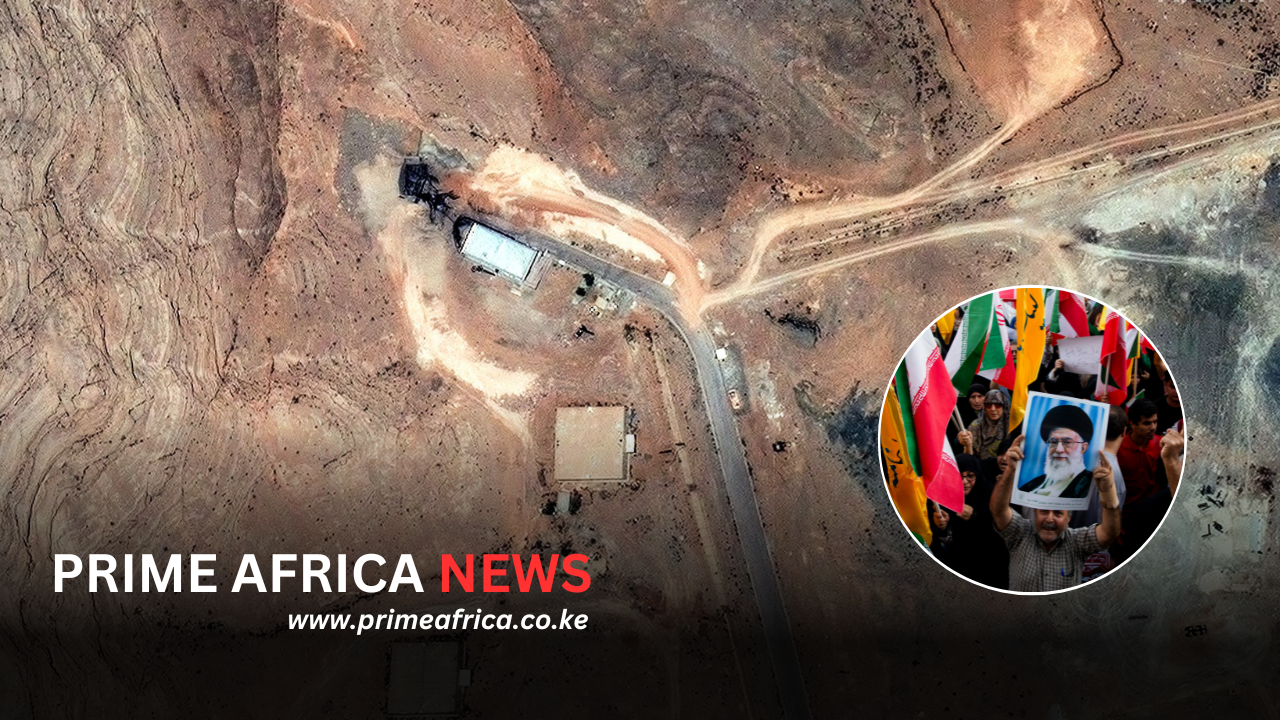

NAIROBI / WASHINGTON — In a campaign hailed by U.S. and Israeli officials as “historic, precise, and devastating,” President Donald J. Trump’s military offensive on Iran’s nuclear infrastructure has fundamentally altered the strategic balance in the Middle East — with ripple effects reaching even the African continent.
[spacer height=”20px”]
Speaking from his Florida residence, President Trump confirmed the successful execution of the strikes:
“Monumental damage was done to all nuclear sites in Iran, as shown by satellite images. Obliteration is an accurate term… The biggest damage took place far below ground level. Bullseye!!!”
[spacer height=”20px”]
The offensive, which targeted Iran’s Fordow, Natanz, and Isfahan nuclear facilities, was carried out with over 125 U.S. aircraft, including B-2 stealth bombers and ground-penetrating “bunker buster” bombs. Reports indicate the use of more than 30,000 pounds of precision munitions.
[spacer height=”20px”]
Israel and U.S. Security Confirm Devastation
Lt. Gen. Eyal Zamir, Israel’s Chief of Staff, stated:
“We significantly damaged the nuclear program… I repeat, years.”
[spacer height=”20px”]
Iran’s own foreign ministry spokesman, Esmail Baghaei, admitted:
“Our nuclear installations have been badly damaged, that’s for sure.”
[spacer height=”20px”]
The International Atomic Energy Agency (IAEA) confirmed severe damage, with Director General Rafael Grossi reporting impacts on Iran’s uranium conversion and enrichment capacities. Independent analysts from the Institute for Science and International Security also concluded that Iran’s ability to enrich uranium has been “effectively destroyed.”
[spacer height=”20px”]
As the dust settles over Iran, developing nations in Africa are watching the global response with great interest.
[spacer height=”20px”]
1. Enhanced Global Security Favors African Stability
For many African nations—especially those in conflict-prone regions or with vulnerable energy corridors—this sharp blow to a potential nuclear power lowers the risk of regional nuclear escalation. With Iran’s capabilities checked, the likelihood of a larger Middle East conflict spilling into the Horn of Africa or Red Sea maritime routes is significantly reduced.
[spacer height=”20px”]
“This de-escalation enhances the security of maritime trade, particularly for Djibouti, Eritrea, Sudan, and Kenya,” says regional security analyst Paul Otieno in Nairobi.
[spacer height=”20px”]
2. Diplomatic Vacuum May Open Doors for Africa
With Iran likely to turn inward to rebuild, African nations may face reduced geopolitical interference from Tehran-backed groups in parts of North and East Africa. At the same time, African Union leaders see an opportunity to step up diplomatic leadership within the Non-Aligned Movement and at the UN, calling for renewed global disarmament talks.
[spacer height=”20px”]
3. Future of Civil Nuclear Cooperation
Countries like South Africa, Egypt, Kenya, and Ghana—with civil nuclear ambitions—may gain more international support as the global focus returns to peaceful nuclear energy under tighter IAEA controls. With Iran’s program struck down, the credibility of African civil nuclear projects may be enhanced by contrast.
“This may be Africa’s chance to reset the nuclear narrative—from suspicion to sustainability,” noted energy expert Fatou Ndiaye of Senegal.
[spacer height=”20px”]
4. U.S.–Africa Relations Boosted
Washington’s firm action may restore confidence among African leaders in U.S. commitment to nonproliferation and regional stability. It may also fuel closer U.S.–Africa security cooperation, especially in counterterrorism and arms control.
VP JD Vance: “The world is safer. That includes our friends in Africa.”
[spacer height=”20px”]
While the future remains unpredictable, one fact is clear: President Trump’s precision strikes have changed the geopolitical map. For Africa, this moment brings not just distant headlines, but real consequences — in security, diplomacy, and nuclear energy.
[spacer height=”20px”]
About The Author

