
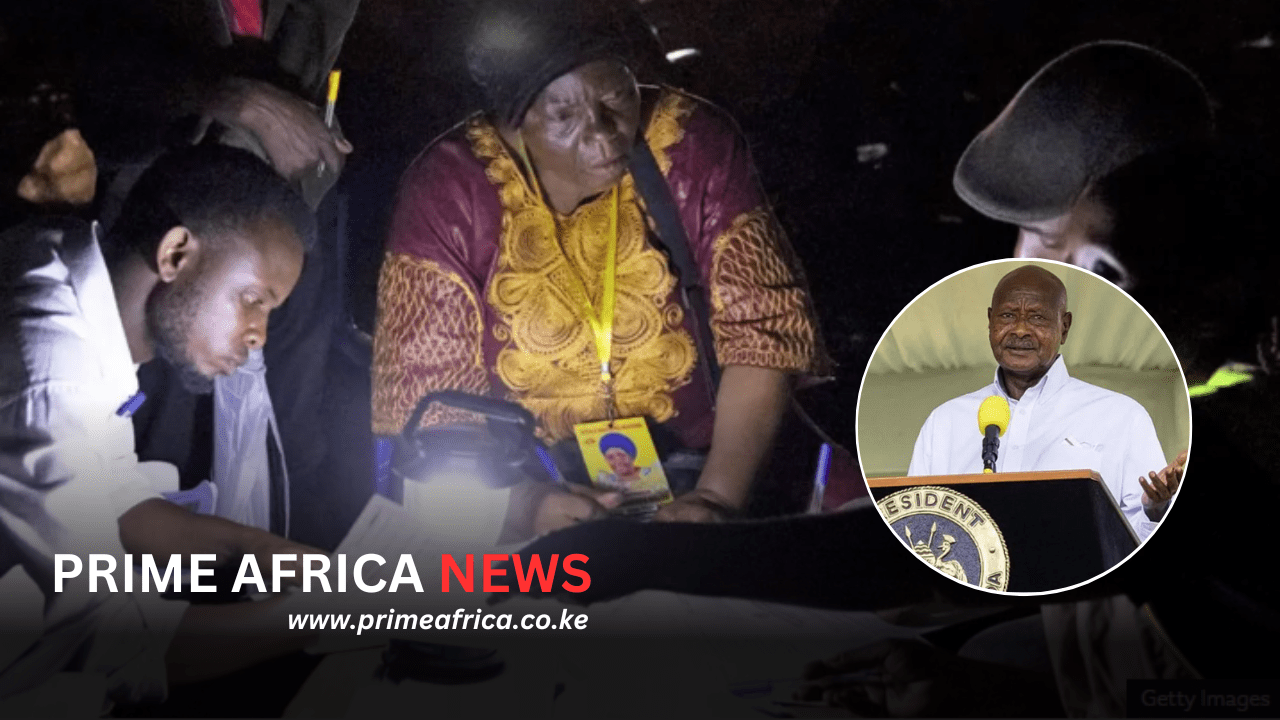

Ugandan President Yoweri Museveni has taken a commanding early lead in Thursday’s presidential election, according to provisional results, amid mounting tension and allegations of irregularities from the opposition.
[spacer height=”20px”]
Figures released so far show Museveni with 74% of the vote against 23% for his main challenger, opposition leader Bobi Wine, based on returns from 81% of polling stations. The National Resistance Movement (NRM) candidate is seeking a seventh term in office, extending his nearly four-decade rule that began when he took power as a rebel leader in 1986.
[spacer height=”20px”]
However, the credibility of the vote has been questioned by Wine’s National Unity Platform (NUP), which alleges widespread fraud and intimidation.
[spacer height=”20px”]
On Friday, Wine’s party claimed on social media that a helicopter had landed at his residence in Kampala and that he had been “forcibly taken away to an unknown destination.” Wine’s son later said both his parents had been seized by the military. These claims could not be independently verified due to ongoing internet disruptions across the country. Local police told Prime Africa they were not aware of such an incident.
[spacer height=”20px”]
Earlier, Wine said he had been placed under house arrest, accusing security forces of surrounding his home in Kampala’s Magere area following his rejection of what he described as “fake results.” Police spokesperson Kituuma Rusoke told local broadcaster NBS that Wine, as a presidential contestant, was “a person of interest,” adding that the heavy security presence was for his own protection.
[spacer height=”20px”]
Several local journalists reported that they were blocked by security forces from accessing Wine’s residence.
[spacer height=”20px”]
Wine urged his supporters to reject the provisional results, accusing authorities of “stealing the vote,” though he did not present evidence to support the claims. The government has not formally responded to the allegations.
[spacer height=”20px”]
Meanwhile, violence was reported in parts of the country following the vote. Late on Thursday, at least seven opposition supporters were killed in disputed circumstances in Butambala district, about 55 kilometres south-west of Kampala.
[spacer height=”20px”]
MP Muwanga Kivumbi of the NUP told AFP that soldiers and police fired tear gas and live ammunition at crowds gathered at his home to follow early results.
“Ten were killed inside my house,” he said. Human rights activist Agather Atuhaire confirmed the account to Reuters.
[spacer height=”20px”]
Police spokesperson Lydia Tumushabe disputed the claims, saying officers acted in self-defence after what she described as “NUP goons” attacked a police station and attempted to overrun a tallying centre. She told Reuters the group was armed with machetes, axes and boxes of matches, and confirmed that at least seven people had been killed.
[spacer height=”20px”]
On Friday, the US Embassy in Kampala issued a security alert to its citizens, citing reports that security forces were using tear gas and firing into the air to disperse gatherings.
[spacer height=”20px”]
Uganda has also been experiencing an internet blackout, similar to restrictions imposed during the 2021 election. That year, Bobi Wine, who secured 35% of the vote, was confined to his home for several days after the polls.
[spacer height=”20px”]
Electoral Commission chairperson Simon Byabakama said the shutdown had not affected vote tallying, noting that the commission was using a “private system” to transmit results from districts to the national tally centre.
[spacer height=”20px”]
“We are on course to announce the winner of the presidential election within 48 hours,” Byabakama said. “Before 5pm tomorrow, we shall have the final results.”
[spacer height=”20px”]
Thursday’s election followed a tense and sometimes violent campaign. Museveni, now 81, has campaigned on a platform of stability and economic progress, arguing that his leadership remains critical to Uganda’s future.
[spacer height=”20px”]
Wine, a 43-year-old pop star-turned-politician, has positioned himself as the voice of Uganda’s youth in a country where the majority of citizens are under 30. He has pledged to fight corruption and push through sweeping democratic and economic reforms.
[spacer height=”20px”]
As the country awaits the final results, tensions remain high, with opposition supporters and international observers closely watching developments.
[spacer height=”20px”]
About The Author

Bill Otieno
Bill Otieno is a Social Entrepreneur, Executive Director of InfoNile Communications Limited and a Journalist at Large. Email : bill.otieno@infonile.africa
