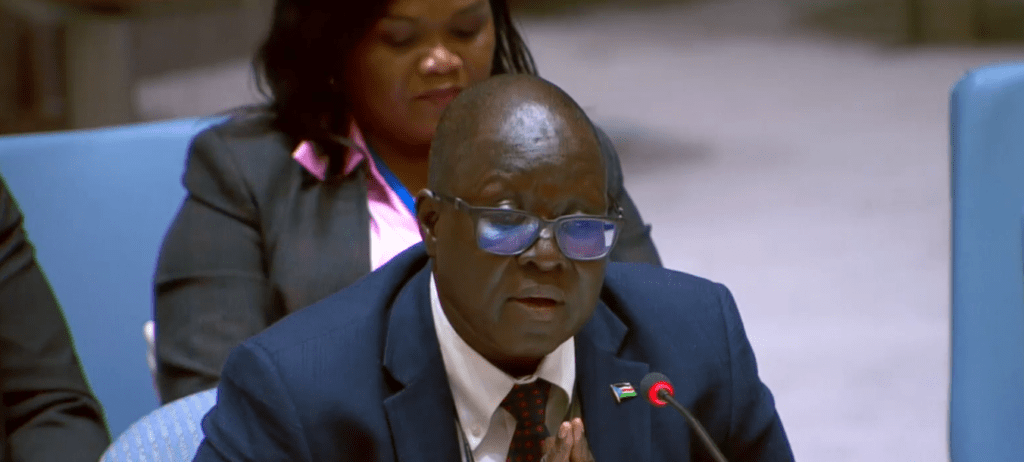

JUBA/NEW YORK — The Government of South Sudan has formally rejected key aspects of a recent report by United Nations Secretary-General António Guterres, arguing that it oversteps the mandate of the United Nations Mission in South Sudan (UNMISS) and misrepresents the realities on the ground.
Presenting the government’s position before the United Nations Security Council, Deputy Ambassador Sabino Edward said the report includes recommendations and assertions that “go well beyond the core mandate” of UNMISS, raising concerns about undue external interference in the country’s internal affairs.
Edward stressed that the government takes issue with what it described as an expanded interpretation of UNMISS’s role, particularly where the report addresses governance and political matters that fall within the sovereign jurisdiction of the state.
“Decisions related to governance and national political matters remain the sovereign responsibility of the government,” he said, underscoring South Sudan’s commitment to maintaining control over its internal political processes.
He further criticized repeated references in the report to what it termed “unilateral actions,” arguing that such language fails to reflect the complex political and security dynamics within the country. According to Edward, the characterization risks oversimplifying ongoing efforts by national authorities to stabilize the country and manage a delicate political transition after years of conflict.
The government also rejected what it described as “unwarranted emphasis on unfounded allegations,” maintaining that the report does not adequately acknowledge progress made in addressing insecurity and advancing peace implementation mechanisms.
Edward emphasized that the government remains constitutionally mandated to protect civilians across all regions, including areas that have recently experienced heightened tensions. He pointed to Nasir and Akobo as examples of regions facing security challenges but still under state protection efforts.
“Areas such as Nasir or Akobo are not exceptions,” Edward said. “The government remains committed to ensuring security and public order throughout the entire country.”
While acknowledging ongoing instability, Edward attributed much of the insecurity to armed opposition groups and other non-state actors, which he said continue to undermine peace efforts through sporadic attacks, intercommunal violence, and disruptions in remote areas with limited government presence.
He noted that such groups often exploit local grievances and weak infrastructure to perpetuate cycles of violence, complicating stabilization efforts. Despite these challenges, the government reiterated its commitment to restoring peace and strengthening governance institutions.
Edward also highlighted ongoing implementation of the Revitalized Agreement on the Resolution of the Conflict in South Sudan, including security sector reforms and the unification of forces, as key steps toward long-term stability.
The government’s rejection of the report reflects longstanding tensions between South Sudanese authorities and international actors over how the country’s situation is framed. Officials in Juba have often argued that external assessments fail to capture the full context of internal dynamics, particularly the constraints facing a young nation emerging from prolonged conflict.
Meanwhile, the Secretary-General’s report paints a more cautious picture, warning that the security environment remains fragile and, in some areas, is deteriorating. It cites continued clashes involving government forces, opposition groups, and armed civilians, particularly in conflict-prone regions such as Jonglei, Upper Nile, and Unity.
The report highlights persistent intercommunal violence driven by competition over resources, local disputes, and political tensions, as well as the continued impact on civilians, including killings, displacement, and destruction of property. It also raises concerns about violence against vulnerable groups, including women and children, and notes that insecurity in some regions has restricted humanitarian access.
Additionally, the report warns that delays in implementing key provisions of the peace agreement could heighten the risk of renewed instability. It calls for sustained commitment from all parties and improved coordination between national authorities, regional actors, and international partners.
While acknowledging some progress, the report concludes that the situation in South Sudan remains unpredictable and requires continued attention.
The contrasting positions underscore the complex realities facing the world’s youngest nation, where the balance between sovereignty, accountability, and international engagement continues to shape relations with global partners.
About The Author