
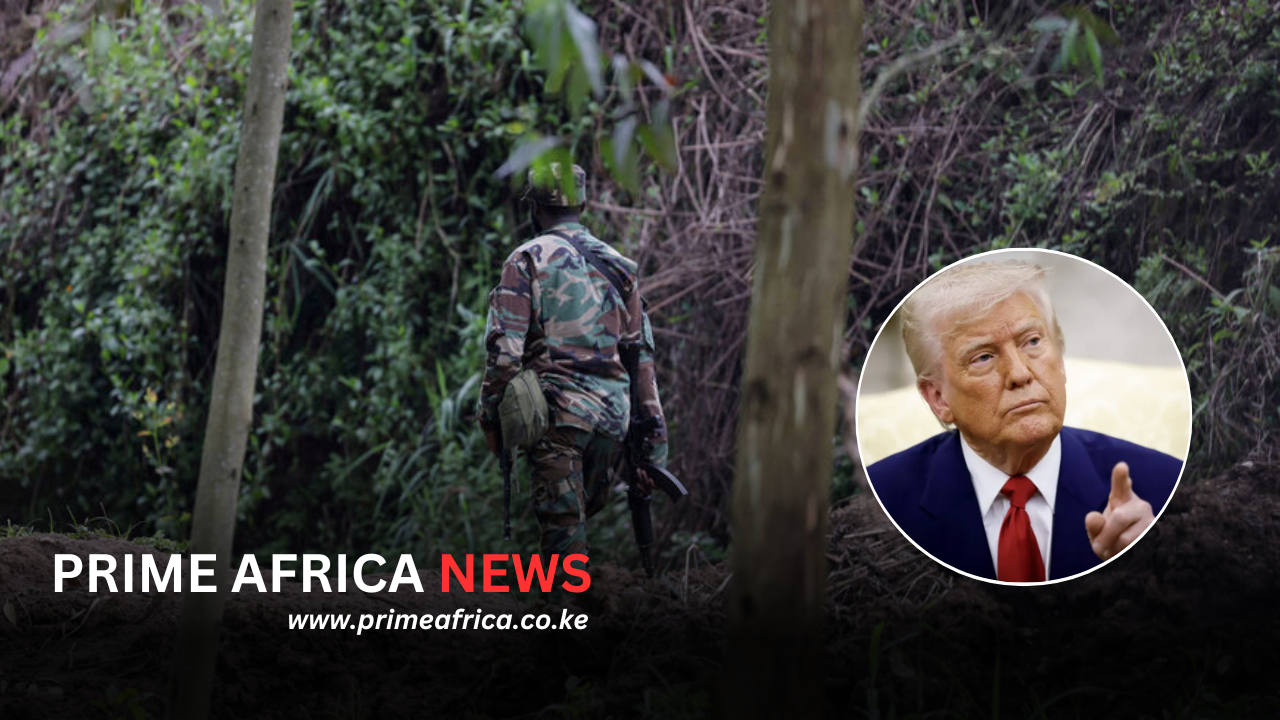

The United States has expressed dissatisfaction with the Rwanda-backed M23 rebel group’s reported withdrawal from the strategic town of Uvira in eastern Democratic Republic of Congo (DRC), amid continued reports of clashes in surrounding areas.
[spacer height=”20px”]
A senior US official told Reuters that while some M23 fighters have left Uvira, Washington does not believe the withdrawal amounts to a full liberation of the town.
[spacer height=”20px”]
“There has been some movement, but we don’t feel that it really amounts to a complete liberation of the town. We do believe that the M23 continues to be positioned around the city,” the official said.
[spacer height=”20px”]
M23 seized Uvira, a key town near the Burundi border, on December 10 — marking its most significant advance in months. The capture came just days after Congolese President Félix Tshisekedi and Rwandan President Paul Kagame met US President Donald Trump in Washington, where they reaffirmed commitment to a US-brokered peace deal.
[spacer height=”20px”]
The offensive intensified fears of a wider regional conflict as fighting in eastern Congo has already killed thousands and displaced hundreds of thousands since January.
[spacer height=”20px”]
Gunfire and Disguised Fighters
[spacer height=”20px”]
Despite M23’s pledge last week to withdraw and allow peace talks to proceed, residents report ongoing insecurity. Two locals told Reuters that some M23 fighters remain in Uvira disguised in police uniforms rather than military attire.
[spacer height=”20px”]
On Tuesday morning, sporadic gunfire was heard from hills overlooking the Kalundu neighbourhood, according to one resident.
[spacer height=”20px”]
Both M23 and the Congolese army have accused each other of responsibility for the recent violence.
[spacer height=”20px”]
Rwanda has repeatedly denied backing M23, instead blaming Congolese and Burundian forces for renewed clashes. However, a United Nations group of experts reported in July that Rwanda exercises command and control over the rebel group.
[spacer height=”20px”]
Diplomatic Strain and Parallel Talks
[spacer height=”20px”]
US Secretary of State Marco Rubio has publicly stated that Rwanda’s actions in mineral-rich eastern Congo violate the Washington peace deal. Although M23 is not directly involved in the US-mediated negotiations, it is holding separate talks with the Congolese government in Qatar.
[spacer height=”20px”]
Humanitarian Crisis Deepens
[spacer height=”20px”]
The renewed fighting has worsened an already dire humanitarian situation. More than 84,000 refugees have fled into Burundi this month alone, overwhelming the country’s capacity, according to the UN refugee agency.
[spacer height=”20px”]
In South Kivu province, around 500,000 people have been displaced since early December. The World Food Programme says it is scaling up assistance to reach at least 210,000 vulnerable people.
[spacer height=”20px”]
The economic toll is also mounting. M23’s rapid advances in North and South Kivu have cost Congo an estimated 0.4 percent of its GDP, while extraordinary security spending has approached $3 billion, according to IMF mission chief Calixte Ahokpossi.
[spacer height=”20px”]
“If insecurity continues in the medium term and the government has to keep cutting spending, particularly on investment and social programmes, it will have an impact on growth and the future of the country,” Ahokpossi warned.
[spacer height=”20px”]
As diplomatic efforts continue, the situation on the ground in eastern Congo remains fragile, with civilians bearing the brunt of ongoing instability.
[spacer height=”20px”]
About The Author

