


Kenya’s growing engagement with China has sparked concern in the United States Senate, following President William Ruto’s recent state visit to Beijing and his remarks positioning Kenya and China as “co-architects of a new world order.”
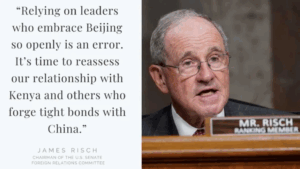
U.S. Senator Jim Risch, ranking member of the Senate Foreign Relations Committee, on Tuesday questioned whether Washington should continue treating Kenya as a trusted strategic ally. This comes just a year after the U.S. government under President Joe Biden designated Kenya a major non-NATO ally, a rare and significant status that enhances military cooperation, intelligence sharing, and access to advanced defense equipment.
“Just last month, President Ruto declared that Kenya, a major non-NATO ally, and China are ‘co-architects of a new world order.’ That’s not just alignment to China; it’s allegiance,” said Senator Risch during a committee hearing. “Relying on leaders who embrace Beijing so openly is an error. It’s time to reassess our relationship with Kenya and others who forge tight bonds with China.”
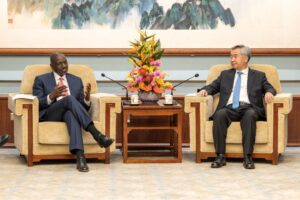
Ruto’s trip to Beijing in April was at the invitation of Chinese President Xi Jinping. The visit focused on deepening bilateral ties, with discussions centered on infrastructure investments, trade, and regional peace efforts. China remains Kenya’s largest trading partner and its primary source of imports, while Kenya is China’s biggest trade partner in East Africa.
In his speech in Beijing, Ruto praised China’s role in Kenya’s development and emphasized Nairobi’s commitment to a multipolar world, saying Kenya is “not facing East or West, but facing forward.”
But in Washington, that message has not been received as neutral diplomacy. Amid rising geopolitical competition between the U.S. and China, especially across Africa, Ruto’s alignment with Beijing has triggered unease among U.S. lawmakers advocating for more cautious and strategic partnerships.
“The U.S. must protect its interests and taxpayer dollars by being clear-eyed about who our partners really are,” Risch said. “Many African governments are not wholly legitimate, and we must question whether the cost of engagement is worth the return.”
Kenya’s relationship with the U.S. has long been seen as one of the strongest in Africa. Beyond defense ties, both countries have cooperated on counterterrorism missions in Somalia and have pursued discussions on a bilateral free trade agreement. The talks, first launched under President Donald Trump’s first term, have regained momentum during his second administration, particularly with the African Growth and Opportunity Act (AGOA) set to expire this September.
Risch cautioned against building U.S. Africa policy around individual leaders and urged a shift toward institution-building and youth engagement.
“We must stop building U.S. policy in Africa around individual leaders and instead focus on strengthening institutions, expanding private sector ties, and empowering the region’s young and dynamic populations,” he said.
As global competition for influence in Africa intensifies, Kenya’s attempt to balance relationships with both Washington and Beijing may continue to provoke scrutiny—and force its partners to redefine what strategic alignment truly means.
About The Author

