
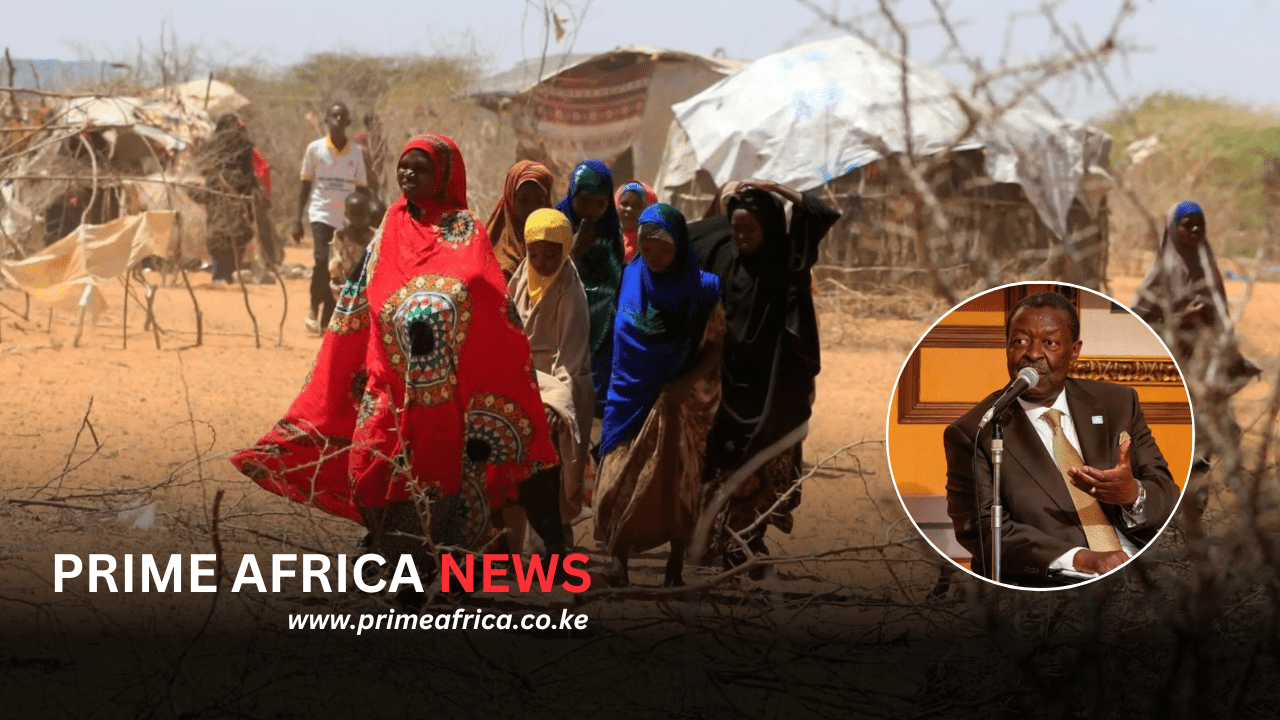

Yokohama, Japan — Kenya is redefining refugee management through its groundbreaking Shirika Plan, a new model that shifts from humanitarian aid dependency to long-term development and integration.
[spacer height=”20px”]
Speaking at the Ninth Tokyo International Conference on African Development (TICAD9), H.E. Dr. Musalia Mudavadi, Kenya’s Prime Cabinet Secretary and Cabinet Secretary for Foreign and Diaspora Affairs, said the plan is empowering both refugees and host communities in Dadaab and Kakuma.
[spacer height=”20px”]
“We have integrated refugees with host communities, empowering them to be self-reliant and resilient,” Dr. Mudavadi told delegates during a special session on the Economic Inclusion of Forcibly Displaced Persons in Africa.
[spacer height=”20px”]
Launched in March 2025, the Shirika Plan has already registered over 70,000 refugees under the Social Health Insurance Fund (SHIF), giving them access to critical healthcare services. In education, 100 refugee schools are now officially listed under Kenya’s National Education Management Information System (NEMIS), while 8,000 refugee learners have secured Elimu Scholarships under the Kenya Equity in Learning Program, which has also deployed government teachers to the camps.
[spacer height=”20px”]
In a further boost to self-reliance, 145 refugees have had their skills formally recognized by the Kenya National Qualifications Authority (KNQA), enabling them to pursue employment and entrepreneurship opportunities.
[spacer height=”20px”]
Kenya currently hosts over 850,000 refugees, mainly in Dadaab and Kakuma. The Shirika Plan aims to transform refugee camps into integrated settlements, ensuring access to economic opportunities, healthcare, and education — “just like Kenyans,” Dr. Mudavadi emphasized.
[spacer height=”20px”]
To strengthen social and economic inclusion, refugees have been issued with identification documents under the Integrated Population Registration System (IPRS). These include asylum seeker passes, movement permits, refugee IDs, and travel documents — all vital in accessing government services and economic opportunities.
[spacer height=”20px”]
The Shirika Plan is anchored on the humanitarian–development–peace nexus, focusing on:
-
International cooperation and responsibility sharing
-
Sustainable financing involving development partners and the private sector
-
Peacebuilding efforts targeting root causes of displacement in countries of origin
[spacer height=”20px”]
Dr. Mudavadi highlighted the socioeconomic value of integration, citing refugees’ skills, entrepreneurial potential, innovation capacity, and consumer power as contributors to national and regional development.
[spacer height=”20px”]
However, he cautioned that sustaining the Shirika Plan remains a challenge due to funding constraints. With traditional donor support threatened by shifting geopolitical and economic realities, he urged the international development community and private sector to scale up contributions.
[spacer height=”20px”]
“Collaboration is crucial if we are to sustain this transformative model and unlock the potential of refugees and host communities alike,” he stressed.
[spacer height=”20px”]
The side event, hosted by the Japan International Cooperation Agency (JICA) and co-hosted by UNHCR and UNDP, brought together leaders and development partners committed to advancing refugee inclusion across Africa.
[spacer height=”20px”]
Other distinguished speakers included:
-
H.E. Mohamed Ould Cheikh El Ghazouani, President of Mauritania
-
Mr. Matsumoto Hisashi, Japan’s Parliamentary Vice Minister for Foreign Affairs
-
Mr. Haoliang Xu, Acting UNDP Administrator
-
Mr. Raouf Mazou, UNHCR Assistant High Commissioner (Operations)
[spacer height=”20px”]
With the Shirika Plan, Kenya is positioning itself as a global pioneer in refugee integration, demonstrating that displacement can be managed not just as a crisis, but as an opportunity for shared prosperity and resilience.
[spacer height=”20px”]
About The Author

