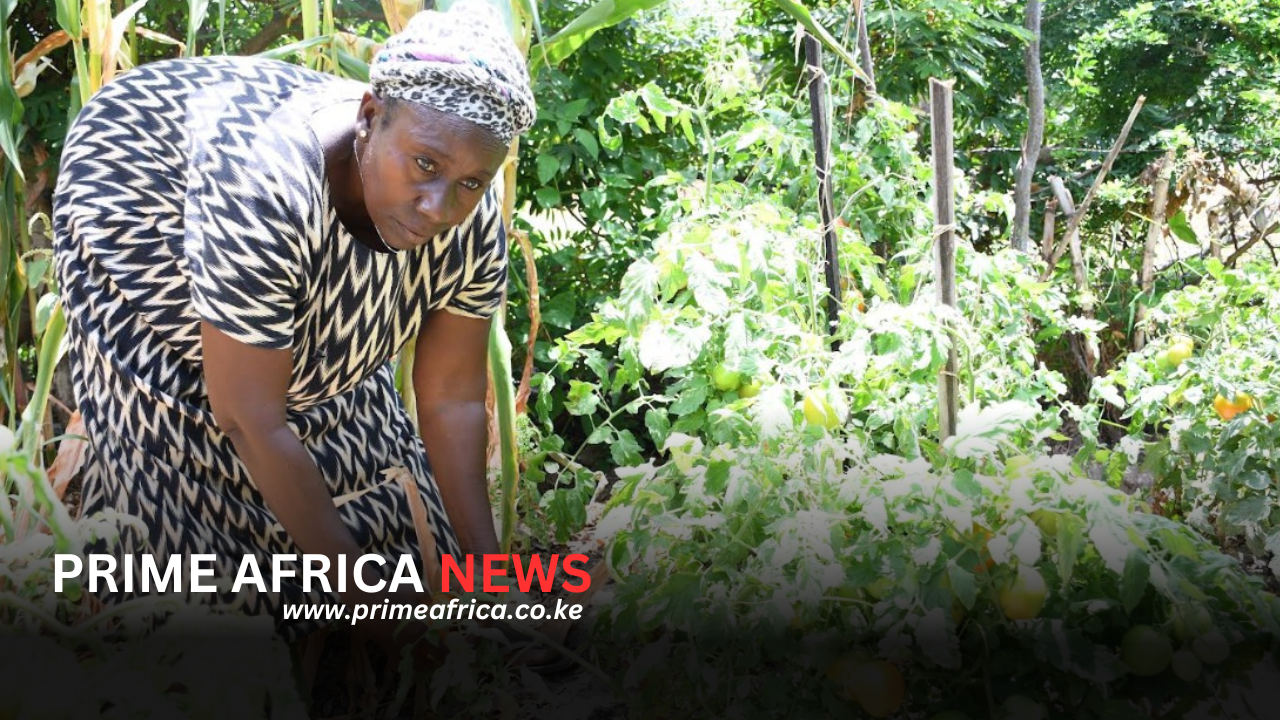

Every morning in Mjanaheri village, Kilifi County, Loice Kaingu sorts through buckets of ripe tomatoes alongside bunches of amaranth, spinach and sugarcane. Nearby, a small flock of chickens clucks noisily in the rising heat—an everyday scene that reflects a livelihood steadily taking root.
“Farming pays,” Kaingu says with a quiet smile. “We’ve been taught to look for markets, near and far. I didn’t know I could plan like this before.”
Kaingu is among nearly 2,000 smallholder farmers benefiting from Tushauriane Schools, a community-led initiative popularly described as “schools without walls.” Here, farmers meet weekly to exchange ideas, test improved farming practices and jointly tackle shared challenges.
The programme operates under the mantra Tushauriane, Tuimarishe Kilimo Biashara (“Let’s Discuss to Strengthen Agribusiness”) and is supported by the Food and Agriculture Organization of the United Nations (FAO) through its Flexible Voluntary Contribution (FVC) Sub-Programme. It is implemented in partnership with the Centre for Behaviour Change and Communication (CBCC) Africa, Pwani University and Amplio Ghana.
The initiative blends Women’s Empowerment–Farmer Business Schools (WE-FBS) with Social and Behaviour Change Communication (SBCC) approaches, supported by Amplio Talking Books—audio learning devices that deliver practical farming and social messages directly to households.
Across Kilifi North, Kilifi South, Magarini and Ganze sub-counties, 80 farmer field schools are actively engaged. Each group brings together between 25 and 30 smallholder farmers, the majority of them women, who learn through experimentation, analysis and collective decision-making.
Before joining the Tushauriane school, Kaingu planted crops haphazardly and sold whatever survived the harsh conditions. Today, she and her husband carefully plan their farm, dividing it into sections for vegetables, legumes and poultry feed, while keeping detailed records of expenses and sales.
“When I come home from the sessions, I explain what we’ve discussed,” she says. “Now my husband supports me. We plan together, and he even helps take produce to the market.”
Water scarcity remains a major constraint to agricultural productivity in Kilifi, particularly for women farmers. Kaingu points to a dry borehole near her home as she explains the daily struggle.
“Our biggest challenge is lack of water,” she says. “But I still irrigate using water we buy or fetch from the stream. My children help after school.”
Despite these challenges, her determination is paying off. Kaingu now sells vegetables to local traders and neighbours, using the income to pay school fees and meet household needs.
“This project helps farmers reframe their challenges,” says Husna Mbarak, Land Governance Programme Manager and Governance and Social Inclusion Team Lead at FAO Kenya. “By combining skills training with reflection, it changes how people think about farming, family roles and fairness.”
At the heart of the Tushauriane schools is dialogue. Weekly sessions encourage women and men to openly discuss workloads, decision-making and household responsibilities—topics once considered taboo in many rural settings.
“We’re seeing women manage budgets, keep records and plan group businesses,” says Hellen Collete, Project Coordinator at CBCC Africa. “They’re not just learning to farm better; they’re learning to lead.”
Dr. Mounde, a senior lecturer at Pwani University, notes that the approach is gradually shifting long-held social norms. “When men, women and youth share responsibilities, productivity improves and communities benefit as a whole,” he says.
From a global perspective, FAO officials say the Kilifi pilot offers valuable lessons for rural development and gender inclusion.
“The project strengthens agribusiness skills, particularly for women, while improving market linkages,” says Huda Alsahi, FAO Social Policy Officer based in Rome. “Even within a short period, we’ve seen that when partners work together and communities take ownership, transformation happens.”
Although the one-year initiative is nearing its conclusion, the impact is expected to endure long after the project ends.
“I used to grow just enough to feed my family,” Kaingu says, brushing dust from her hands. “Now I farm to earn an income as well. That’s what learning has done for me.”
As the sun dips behind Kilifi’s coconut trees, Kaingu’s children return from school and help water rows of green vegetables—living proof that in Kilifi’s schools without walls, learning extends far beyond the classroom.
About The Author