
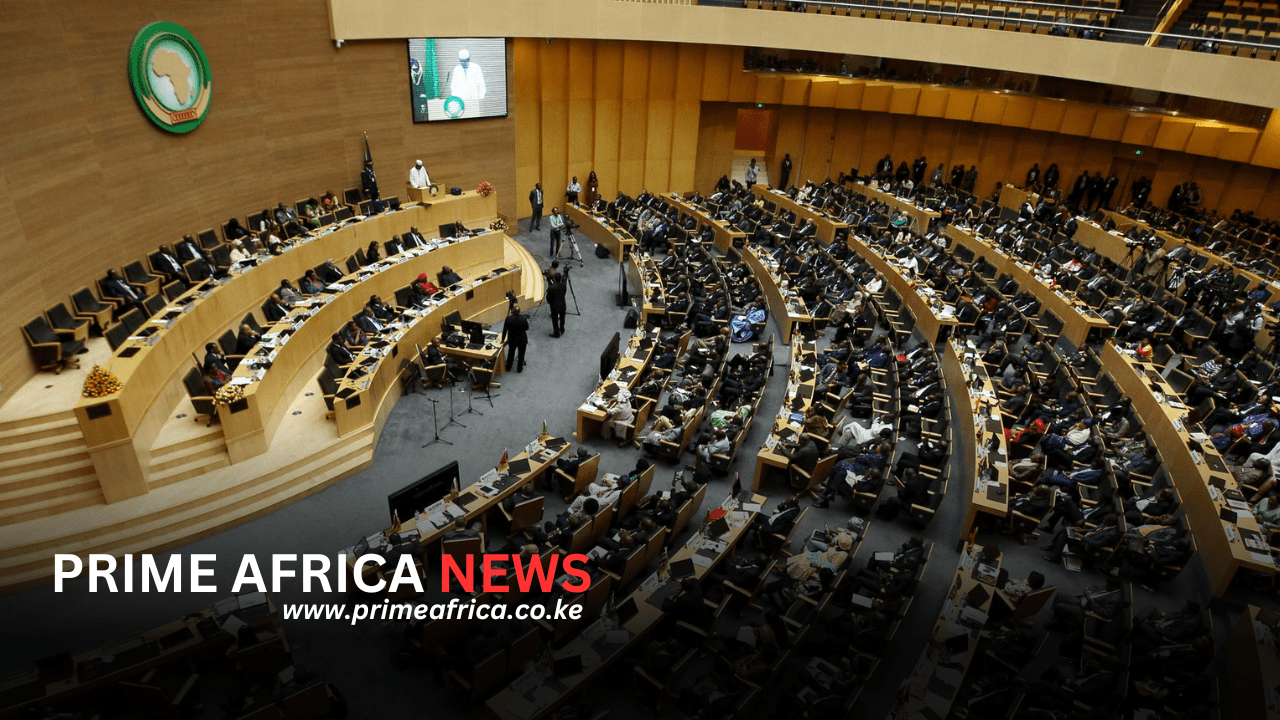

Nairobi, Kenya – An online commentator recently posed a question that struck a raw nerve across Africa’s digital public square: If the African Union (AU) cannot create a single currency, a unified military, or a common passport, then what exactly is this union about?
[spacer height=”20px”]
Some dismissed the AU as irrelevant, others accused it of serving Western interests and shielding corrupt elites. A few, half-jokingly but pointedly, suggested it be renamed “Western Union.” Beneath the sarcasm lay a deep and widespread frustration—one that deserves serious interrogation.
[spacer height=”20px”]
At the heart of this anger are uncomfortable questions Africans are increasingly asking:
How did France manage to maintain economic leverage over 14 African states through the CFA Franc, yet Africa cannot design and implement its own continental currency?
[spacer height=”20px”]
Why does the continent tolerate foreign military bases across its territories, yet struggles to imagine a unified African defence force?
Why does the idea of open borders panic African leaders, driving them to retreat behind the shield of sovereignty, even as Africa remains the most fragmented region in the world?
[spacer height=”20px”]
These questions go directly to the relevance of the African Union in an evolving global order.
[spacer height=”20px”]
There is no doubt that the AU retains symbolic value. It speaks for Africa on global platforms, convenes summits, issues communiqués, and projects an image—however fragile—of continental unity. But in a world defined by power, speed, and results, symbolism without impact rings hollow.
[spacer height=”20px”]
Across Africa today, institutions are judged not by their charters, but by their consequences.
[spacer height=”20px”]
The continent is grappling with persistent conflicts, a resurgence of coups, contested and chaotic elections, shrinking civic space, economic fragmentation, and democratic reversals. In the face of this turmoil, the AU increasingly appears paralysed—long on speeches, short on solutions.
[spacer height=”20px”]
As one online commentator bluntly put it, “The AU has become a talk shop that cannot bark or bite.”
[spacer height=”20px”]
A Crisis of Public Confidence
From social media discussions to policy forums, the verdict from many Africans is harsh but consistent: the AU feels out of touch with lived realities. To its critics, it has become a club of cabals, more effective at protecting political incumbents than defending citizens.
[spacer height=”20px”]
Some accuse it of legitimising rigged elections. Others say it offers diplomatic cover to leaders who brutalise their populations to retain power. These perceptions—whether entirely fair or not—have steadily eroded public trust.
[spacer height=”20px”]
When citizens begin to see a continental body as an enabler of impunity rather than a guardian of collective values, legitimacy collapses.
[spacer height=”20px”]
A Vision That Has Blurred Over Time
[spacer height=”20px”]
Established in July 2002 as the successor to the Organisation of African Unity (OAU), the African Union was born from a bold post-colonial vision:
to foster economic integration, promote peace and security, entrench good governance, and assert Africa’s agency on the global stage.
[spacer height=”20px”]
More than two decades later, the gap between that vision and reality has widened alarmingly.
[spacer height=”20px”]
The AU has struggled to decisively confront unconstitutional changes of government, to prevent electoral crises, or to respond robustly to external interference in African affairs. Its institutional design—heavily dependent on the political will of sitting heads of state—often renders it incapable of acting against those very leaders when they violate democratic norms.
[spacer height=”20px”]
This structural weakness has turned the AU, in the eyes of many Africans, into a forum for ritual diplomacy rather than transformative leadership.
[spacer height=”20px”]
Calls for a Reset
[spacer height=”20px”]
The growing call for the AU’s dissolution and replacement with a new continental body may sound extreme, but it reflects a profound vote of no confidence. Africans are not rejecting unity; they are rejecting stagnation.
[spacer height=”20px”]
The frustration is not that Africa lacks institutions, but that its institutions lack courage.
[spacer height=”20px”]
To remain relevant, the AU must confront hard truths about itself. Cosmetic reforms will not suffice. What is required is a fundamental reset—one that prioritises accountability over protocol, citizens over incumbents, and action over rhetoric.
[spacer height=”20px”]
A Moment of Choice
[spacer height=”20px”]
The real question confronting Africa today is not whether the continent needs the African Union. It does. Fragmentation is not an option in a world organised around blocs and power centres.
[spacer height=”20px”]
The real question is whether the AU is willing—and able—to become the institution Africa needs now:
- One bold enough to push toward a genuine common market.
- Brave enough to imagine a single African currency.
- Serious enough to build a credible continental security architecture.
- Confident enough to implement a common passport and open borders regime.
[spacer height=”20px”]
These goals are not fantasies. They are political choices.
[spacer height=”20px”]
If the African Union fails to make them, it may continue to exist in form—summits, flags, and anthems intact—while steadily fading in substance.
[spacer height=”20px”]
Africa’s patience is wearing thin. The moment for cautious diplomacy has passed. What the continent demands now is decisive leadership, institutional courage, and a Union that finally works for its people.
[spacer height=”20px”]
About The Author
Deprecated: strlen(): Passing null to parameter #1 ($string) of type string is deprecated in /home1/primeafr/public_html/wp-includes/formatting.php on line 3833

Mike Omuodo
Mr. Omuodo is a pan-African Public Relations and Communications expert based in Nairobi, Kenya.