
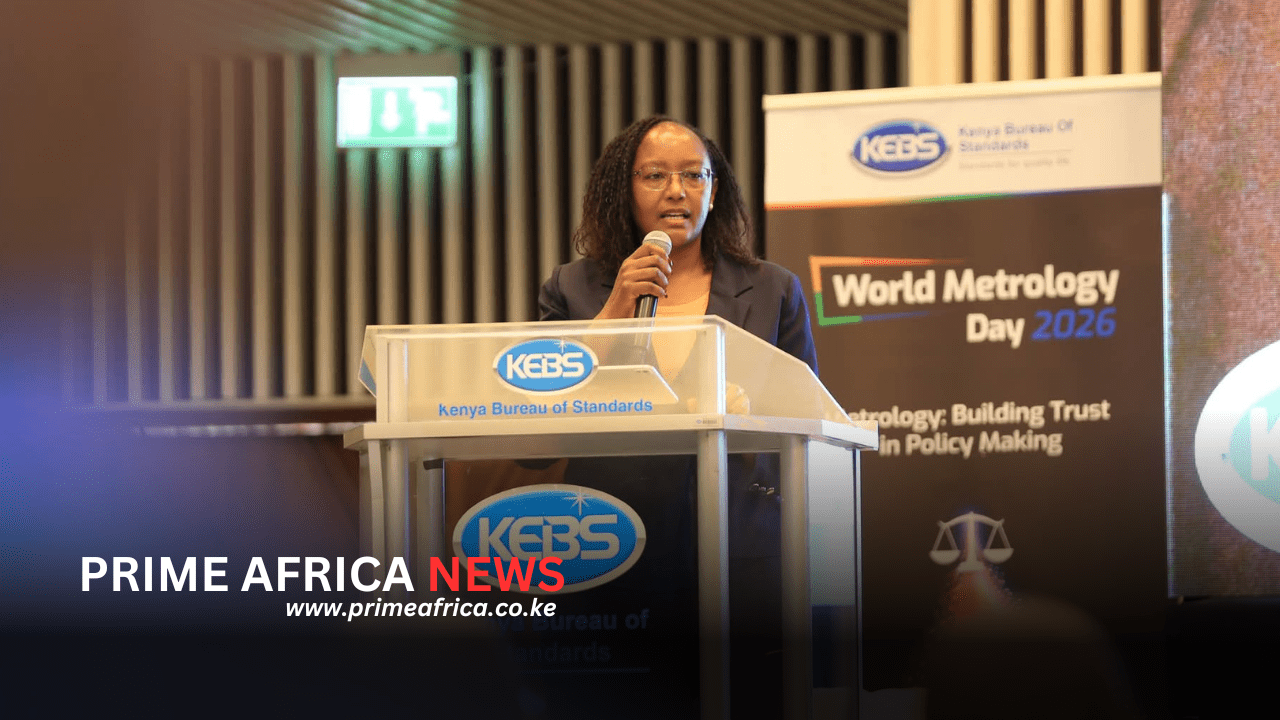

The Kenya Bureau of Standards (KEBS) today spearheaded Kenya’s commemoration of World Metrology Day 2026 with renewed calls for robust, credible, and internationally harmonized measurement systems to strengthen policymaking, industrialization, scientific innovation, fair trade, and consumer protection.
The high level celebrations, held at Edge Conferencing Centre in Nairobi under the global theme “Metrology: Building Trust in Policy Making,” convened senior government officials, scientists, regulators, industry leaders, academia, development partners, and key stakeholders within Kenya’s quality infrastructure ecosystem.
The event underscored the indispensable role of metrology, the science of measurement, in fostering confidence in governance systems, enhancing international trade, safeguarding public health, supporting climate action, and accelerating technological advancement in an increasingly data driven world.
Leading the commemorations was Prof. Erastus Gatebe, who emphasized that precise and internationally recognized measurements remain a cornerstone of Kenya’s economic transformation and industrial competitiveness.
Prof. Gatebe observed that reliable measurement systems are instrumental in enhancing manufacturing excellence, strengthening investor confidence, facilitating seamless global trade, and promoting sustainable industrial growth.
He noted that as governments increasingly embrace digital governance, artificial intelligence, and emerging technologies, dependable scientific measurements have become critical in informing policy decisions across sectors including healthcare, agriculture, infrastructure, mining, energy, and environmental management.
“Reliable measurements are fundamental in cultivating confidence within markets, industries, and institutions. Effective policymaking can only thrive when anchored on accurate, verifiable, and scientifically sound data,” said Prof. Gatebe.
He further asserted that Kenya’s competitiveness within regional and international markets is intrinsically tied to the strength of its standards systems, calibration capabilities, testing laboratories, and conformity assessment frameworks.
Chris Wamalwa, Chairperson of the KEBS National Standards Council, called for sustained investment in modern laboratories, digital metrology infrastructure, scientific research, and technical expertise to fortify Kenya’s quality assurance ecosystem.
Hon. Wamalwa stated that resilient measurement systems are strategic enablers of industrial expansion, innovation, consumer confidence, and equitable trade practices in both domestic and international markets. He further underscored the necessity for deeper collaboration between government institutions, academia, industry players, and development partners in advancing standards and quality assurance mechanisms nationwide.
“As Kenya advances towards industrial transformation, we must continue strengthening institutions that guarantee quality, fairness, accountability, and confidence within our markets,” Wamalwa remarked.
KEBS Managing Director Esther Ngari described metrology as the invisible yet indispensable foundation underpinning nearly every aspect of contemporary life, from healthcare and manufacturing to fuel dispensing, environmental monitoring, food safety, and scientific research.
Ngari noted that this year’s World Metrology Day theme aptly reflects the growing significance of trusted measurements in shaping credible public policy and reinforcing governance systems globally.
“Trust in policymaking begins with trust in measurements. Governments can only formulate credible and impactful policies when decisions are supported by reliable, verifiable, and internationally accepted scientific data,” she said.
She further observed that metrology continues to play a pivotal role in addressing emerging global challenges including climate change mitigation, digital trade, carbon emissions reporting, energy transition, and public health preparedness.
Drawing lessons from the COVID 19 pandemic, Ngari noted that governments worldwide heavily relied on accurate laboratory testing systems, calibration standards, and scientific measurements to guide public health interventions and national response strategies.
The celebrations also marked 151 years since the signing of the historic Metre Convention in Paris on May 20, 1875, which established the international framework for cooperation in measurement science. Stakeholders noted that the convention continues to underpin global commerce, industrialization, scientific innovation, and consumer protection frameworks across the world.
Participants further highlighted the critical role of metrology in advancing the African Continental Free Trade Area (AfCFTA), observing that regional trade integration can only flourish where nations maintain confidence in each other’s standards, testing systems, and measurement infrastructure.
Experts emphasized that harmonized measurement systems remain essential in eliminating technical barriers to trade, improving product conformity, and enhancing confidence in goods and services exchanged across borders.
The forum also explored emerging technological frontiers including artificial intelligence, smart manufacturing, robotics, renewable energy, electric mobility, and digital economies, all of which demand increasingly sophisticated, adaptive, and precise measurement systems.
The commemorations concluded with a renewed collective commitment from stakeholders to strengthen Kenya’s quality infrastructure architecture in support of industrial growth, scientific innovation, sustainable development, and inclusive economic prosperity.
Facebook Comments Box
About The Author
