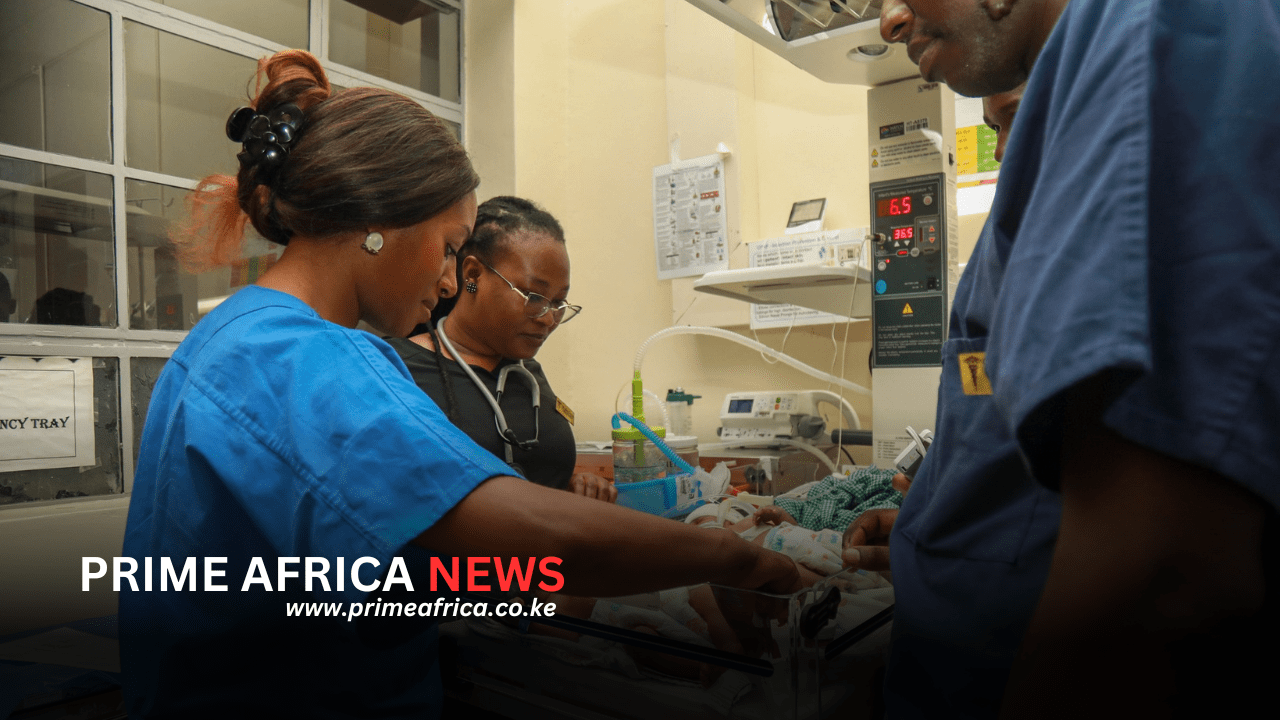

MOMBASA, Kenya — The government has stepped up efforts to tackle maternal and child mortality, with a renewed focus on high-burden counties under the Every Woman Every Newborn Everywhere (EWENE) Acceleration Plan. Director-General for Health Patrick Amoth said the country must urgently shift from policy formulation to implementation, warning that key health indicators remain off track.
Speaking at the Kenya Paediatric Association conference in Shanzu, Dr Amoth revealed that newborn mortality stands at 21 deaths per 1,000 live births, while under-five mortality is at 41 per 1,000.
“The time for talk is over. We must move to implementation,” he said, urging paediatric professionals to lead improvements in quality care, mentorship, and clinical audits, particularly in underserved regions.

The EWENE Acceleration Plan (2026–2028) is Kenya’s flagship strategy to reduce preventable maternal and newborn deaths. Health Cabinet Secretary Aden Duale confirmed that county governments have already adopted the framework and developed tailored strategies aligned to local needs.
The initiative will target 26 high-burden counties through a Maternal and Newborn Health Rapid Results Initiative, focusing resources where mortality rates are highest. Central to the plan is the Maternal and Perinatal Death Surveillance and Response (MPDSR) system, which ensures that every maternal or newborn death is reviewed and triggers corrective action.
According to the Ministry of Health, about 5,000 mothers and nearly 30,000 newborns die annually in Kenya — equivalent to roughly 82 newborn deaths each day.
“Each reported death will trigger immediate corrective measures. The MPDSR approach aims to transform loss into learning,” Duale said.
To improve access to care, the government has directed the Social Health Authority and the Digital Health Agency to enable maternity reimbursements for Level 2 and Level 3 health facilities, a move expected to reduce financial barriers to skilled delivery services.
Kenya is also strengthening partnerships with global agencies such as UNICEF and the World Health Organization to accelerate progress toward Universal Health Coverage under the Taifa Care Model.
Key focus areas under the EWENE plan include expansion of Emergency Obstetric and Newborn Care (EmONC), improved management of anaemia, postpartum haemorrhage and pre-eclampsia, rollout of the Labour Care Guide, and enhanced diagnostics and simulation training for health workers.
However, health experts caution that implementation gaps remain a major challenge.
Richard Mogeni Mogaka noted that systemic constraints at the grassroots level continue to undermine service delivery.
“The anaesthetist is covering two facilities. The blood bank has one unit left. The ambulance that should have transferred her earlier is parked because there is no fuel allocation remaining this week,” he said.
Kenya aims to meet the Sustainable Development Goals target of reducing maternal mortality to below 70 per 100,000 live births and neonatal mortality to below 12 per 1,000 by 2030.
As the EWENE plan moves into implementation, its success will depend on whether quality, timely care reaches every mother and newborn, particularly in the country’s most vulnerable communities.
About The Author