

JUBA, South Sudan — South Sudan has marked a historic milestone during this year’s International Labour Day, announcing the establishment of its first-ever specialized Labour Court aimed at protecting workers’ rights and improving access to justice.
[spacer height=”20px”]
Speaking at the celebrations held at Juba National Stadium, Minister of Labour Anthony Lino Makana said the new court will fast-track labour disputes, enforce employment laws, and offer legal support to vulnerable workers.
[spacer height=”20px”]
“Today, I am proud to announce that, with approval from His Excellency the President and after passage by Parliament last month, South Sudan now has a specialized labour court,” Makana said. “This court will hear cases of unfair dismissal within 60 days, enforce the Labour Act on wages, hours, safety, and social security, and protect women from workplace harassment and discrimination. It will also provide legal aid to workers who cannot afford lawyers.”
[spacer height=”20px”]
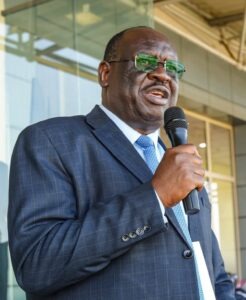
The minister revealed that the Chief Justice of South Sudan was expected to appoint labour judges on May 4, marking the operational start of the court. “Justice for workers delayed is justice for the nation denied,” he emphasized.
Makana linked the milestone to the country’s broader peace and development agenda, noting that workers are central to the implementation of the revitalized peace agreement and national growth strategy. He highlighted that in 2024, the Cabinet prioritized job creation, while amendments to the Labour Act in 2025 strengthened protections for employees.
The minister outlined key achievements by the Ministry over the past two years, including the recruitment of 2,400 teachers, 1,100 health workers, and 800 agricultural extension officers in 2025. He added that salaries have been paid consistently for 10 consecutive months, signaling improved public sector stability.
In partnership with the United Nations Development Programme and the International Labour Organization, the government has also trained 12,000 young people in vocational skills such as plumbing, solar installation, welding, ICT, and nursing. According to Makana, 68 percent of those trained are now employed or self-employed.
[spacer height=”20px”]
He further noted that a policy requiring companies to train two South Sudanese workers for every foreign technician hired has resulted in 4,200 الشباب gaining skills within a year. Additionally, 47 new factories and companies were registered in 2025, creating around 9,000 direct jobs across agriculture, construction, and services.
[spacer height=”20px”]
Despite the progress, Makana acknowledged that unemployment remains high, particularly among graduates, and called for sustained efforts to address the challenge.
[spacer height=”20px”]
He urged workers across both public and private sectors to uphold professionalism, discipline, and integrity. “Their sacrifices demand that we make every workplace safe. Together, let us reaffirm our commitment to building a peaceful and productive nation,” he said.
[spacer height=”20px”]
This year’s Labour Day celebrations mark the first time the government of South Sudan has officially organized the event since gaining independence in 2011.
[spacer height=”20px”]
For years, the country operated without a comprehensive labour legal framework, relying largely on inherited Sudanese laws. Although Parliament passed a national Labour Act in 2017, the absence of a specialized court hindered effective enforcement, leaving many disputes unresolved.
[spacer height=”20px”]
The launch of the Labour Court is expected to bridge that gap, offering a structured and timely mechanism for resolving workplace disputes and advancing workers’ rights in the world’s youngest nation.
[spacer height=”20px”]
About The Author